 AI for Everyone
Perspectives· Website security
PHP2Shell Vulnerability: What Website Owners and Users Should Do
Sources as of 2026-10-22 · 6 models
Read the full articleKey findings
- 01
Different emphasis · Grok 4.7
Emphasizes that the pack does not compare live and offline patching.
- 02
Different emphasis · Grok 4.7
Adds speed, acceptable compatibility and control over systems.
- 03
Shared view
All describe the advice as patch immediately, or take systems offline if immediate patching is not possible.
Model comparison
6 models · Same sources & questions
| Model | Position |
|---|---|
| GPT-6 Astra | Discusses lost sales, service access and exposure until a fix works. Says Hadrian's general cost judgment does not establish that downtime is affordable for every business. |
| Claude Sonnet 5 | Suggests fewer IT staff could mean longer downtime and greater costs relative to business size, but says the sources cannot confirm or measure this. |
| Gemini 4 Argon | Focuses on downtime versus compromise and lost trust. Notes that the sources do not distinguish small businesses. |
| Grok 4.7 | Emphasizes that the pack does not compare live and offline patching. Suggests compatibility problems could extend downtime beyond a few hours. |
| Mistral Large | Infers lost sales, customer frustration, reputation damage and limited staff. Calls offline patching immediate security and warns online fixes may be delayed or incomplete. |
| DeepSeek V4 Pro | Applies the general downtime-versus-compromise logic to small businesses without adding a detailed account of their costs. |
Shared views & assumptions12 points
Where they agree
- All describe the advice as patch immediately, or take systems offline if immediate patching is not possible.
- All identify a trade-off between service downtime and the risk of server compromise.
- All acknowledge that the sources do not give a specific cost analysis for small businesses.
- All identify finding every PHP instance as a barrier to patching quickly. Unknown instances can remain vulnerable after known ones are fixed.
- All say uncertainty about access to exploit information before disclosure should not delay urgent action.
- All treat evidence of patch compatibility failures as strengthening the case for going offline when those failures prevent immediate patching.
Shared assumptions
- The comparison concerns how the answers describe the source pack. The pack itself is not supplied here for independent checking.
- The downtime-versus-compromise argument assumes shutdown reduces exposure and that its costs are acceptable. GPT-6 Astra explicitly questions whether the cost claim holds for every business.
- Immediate patching assumes owners can find, access and update affected systems. Several answers also assume they can check compatibility or avoid unacceptable failures.
- Most proposed business costs and indirect effects are possibilities, not measured outcomes in the pack. Gemini 4 Argon declines to extend the shutdown discussion this way.
- Compatibility problems in question 5 are hypothetical evidence. Difficulty designing a compatible fix is not the same claim as released patches causing failures.
- An attempt before disclosure does not by itself establish how the actor obtained information or whether a leak caused that attempt.
Questions & method5 questions
- What are the trade-offs between immediately taking a site offline to patch and keeping it online while applying the fix, especially for small businesses?
- What assumptions are built into the recommendation to patch immediately, and how might those assumptions fail for organisations with many hidden or legacy PHP instances?
- What second-order effects could result from widespread shutdowns of PHP-based sites even among owners who were not directly attacked?
- How much uncertainty remains about whether the vulnerability was leaked before the official disclosure, and how should that change a website owner's urgency?
- What new information, such as evidence that a patch causes compatibility failures, would change the conclusion to take systems offline rather than patch in place?
The comparison was drafted by GPT-6 Astra (also a participant) and checked by a person. Model statements are not verified facts; check the cited source lines.
Original model answers6 answers
GPT-6 Astra
1. Taking a site offline versus patching while it stays online, especially for small businesses
What the sources state: Patches are available, and some sites taken down for patching returned quickly [L78]. Security firms recommend immediate patching and taking systems offline when immediate patching is not possible [L80]. Hadrian argues that a few hours of shutdown costs much less than a compromised server [L82]. The potential compromise includes access to a server’s file system or database [L50]. The source does not compare online and offline patching procedures or provide small-business cost estimates.
Inference: Taking a site offline trades immediate service disruption—and potentially lost sales or customer access—for reduced exposure while remediation is completed. Patching while online could preserve service, but leaves a potential exposure window until the fix is effective. For a small business, the balance depends on its reliance on continuous availability and its ability to patch reliably. Hadrian’s cost comparison is a general judgment, not evidence that downtime is affordable for every business.
Confidence: medium. The security recommendation is explicit, but the small-business trade-offs and feasibility of online patching are not examined.
2. Assumptions behind immediate patching, and hidden or legacy instances
What the sources state: Patches are already available [L78], but timely remediation depends on organisations knowing they need to patch [L84]. Sophos identifies “finding and managing every instance where PHP is running” as the immediate challenge [L86]. The PHP Foundation says the vulnerabilities’ central location made fixes difficult without breaking compatibility, hurting performance, or requiring changes to third-party extensions [L68].
Inference: An immediate-patching recommendation assumes an organisation can identify affected instances, access and update them, and verify that the updated applications still work. Hidden instances undermine coverage: patching known servers does not establish that all PHP deployments are fixed. Legacy deployments could complicate compatibility or extension changes and make rapid rollout harder. The source does not establish which legacy versions have patches or whether any remain unsupported.
Confidence: medium. Inventory and compatibility challenges are directly supported, but specific legacy-version limitations are not documented.
3. Second-order effects of widespread shutdowns
What the sources state: Websites worldwide were taken offline while governments and businesses patched [L24]. PHP is estimated to serve 70% of websites [L38], and Drupal-based government platforms are among those affected; Australia’s GovCMS supports 391 government websites [L40]. Some shutdowns were brief [L78]. The source does not quantify wider economic or social consequences.
Inference: Even without a direct attack, precautionary shutdowns could interrupt commerce, publishing, and access to government information or services. Simultaneous outages could also disrupt organisations that depend on affected sites, shift demand toward alternative services, and increase support requests from confused users. Owners may incur remediation and downtime costs despite having suffered no confirmed compromise. These are plausible consequences of broad disruption, not measured outcomes in the source.
Confidence: medium. The scale and precautionary nature of shutdowns are established, but the downstream effects are inferred.
4. Uncertainty about an early leak and implications for urgency
What the sources state: The PHP Foundation says vulnerability information began circulating before the planned 22 October disclosure, prompting an earlier release [L62]. Nevertheless, the article explicitly says it is unclear whether the vulnerability was leaked ahead of time [L96]. Amazon reports an exploitation attempt four days before public disclosure, but says the actor’s means of obtaining exploit information remain unclear [L96–L98]. Hadrian reports exploitation “at scale” [L72]. The retrieved article is shortened and ends mid-sentence, limiting the available account [L6, L100].
Inference: The source supports early circulation and a reported pre-disclosure exploitation attempt, but does not resolve who disclosed information, how the actor acquired it, or whether a leak caused that attempt. Website owners should not wait for that attribution question to be settled: reported exploitation already supports urgent remediation. Possible earlier targeting also means owners should not assume their exposure began only at public disclosure.
Confidence: high. The source explicitly distinguishes uncertain information provenance from reported exploitation that warrants urgent action.
5. New information that would change the offline-versus-in-place decision
What the sources state: The recommendation is conditional: patch immediately, and take systems offline if immediate patching cannot be done [L80]. It is not a blanket instruction to shut down every site. Compatibility, performance, and third-party-extension concerns made the fixes difficult to develop [L68], but the source does not report that released patches actually cause failures or describe how to determine whether patching in place is safe.
Inference: Decision-changing information would include:
- Verified, successful in-place patching on the relevant configuration: This would favour remaining online if remediation can be completed immediately and its effectiveness confirmed.
- Reproducible patch compatibility failures: These would generally strengthen the case for temporary shutdown if they prevent effective immediate remediation—not justify leaving a vulnerable system exposed.
- Reliable evidence that a particular instance is unaffected, or that a temporary mitigation blocks exploitation: This could weaken the case for shutdown, but neither is established in the pack.
- Evidence that an apparently completed update leaves vulnerable instances running: This would favour taking those instances offline until remediation is verified.
The key distinction is whether new evidence establishes safe continued operation or instead shows that effective patching will be delayed.
Confidence: medium. The conditional recommendation is clear, but the evidence needed to choose a deployment method is inferred rather than specified by the source.
Original answer and model details
Requested: openai/gpt-6-astra · Returned: gpt-6-astra
### 1. Taking a site offline versus patching while it stays online, especially for small businesses

**What the sources state:** Patches are available, and some sites taken down for patching returned quickly [L78]. Security firms recommend immediate patching and taking systems offline when immediate patching is not possible [L80]. Hadrian argues that a few hours of shutdown costs much less than a compromised server [L82]. The potential compromise includes access to a server’s file system or database [L50]. The source does not compare online and offline patching procedures or provide small-business cost estimates.

**Inference:** Taking a site offline trades immediate service disruption—and potentially lost sales or customer access—for reduced exposure while remediation is completed. Patching while online could preserve service, but leaves a potential exposure window until the fix is effective. For a small business, the balance depends on its reliance on continuous availability and its ability to patch reliably. Hadrian’s cost comparison is a general judgment, not evidence that downtime is affordable for every business.

**Confidence: medium.** The security recommendation is explicit, but the small-business trade-offs and feasibility of online patching are not examined.

### 2. Assumptions behind immediate patching, and hidden or legacy instances

**What the sources state:** Patches are already available [L78], but timely remediation depends on organisations knowing they need to patch [L84]. Sophos identifies “finding and managing every instance where PHP is running” as the immediate challenge [L86]. The PHP Foundation says the vulnerabilities’ central location made fixes difficult without breaking compatibility, hurting performance, or requiring changes to third-party extensions [L68].

**Inference:** An immediate-patching recommendation assumes an organisation can identify affected instances, access and update them, and verify that the updated applications still work. Hidden instances undermine coverage: patching known servers does not establish that all PHP deployments are fixed. Legacy deployments could complicate compatibility or extension changes and make rapid rollout harder. The source does not establish which legacy versions have patches or whether any remain unsupported.

**Confidence: medium.** Inventory and compatibility challenges are directly supported, but specific legacy-version limitations are not documented.

### 3. Second-order effects of widespread shutdowns

**What the sources state:** Websites worldwide were taken offline while governments and businesses patched [L24]. PHP is estimated to serve 70% of websites [L38], and Drupal-based government platforms are among those affected; Australia’s GovCMS supports 391 government websites [L40]. Some shutdowns were brief [L78]. The source does not quantify wider economic or social consequences.

**Inference:** Even without a direct attack, precautionary shutdowns could interrupt commerce, publishing, and access to government information or services. Simultaneous outages could also disrupt organisations that depend on affected sites, shift demand toward alternative services, and increase support requests from confused users. Owners may incur remediation and downtime costs despite having suffered no confirmed compromise. These are plausible consequences of broad disruption, not measured outcomes in the source.

**Confidence: medium.** The scale and precautionary nature of shutdowns are established, but the downstream effects are inferred.

### 4. Uncertainty about an early leak and implications for urgency

**What the sources state:** The PHP Foundation says vulnerability information began circulating before the planned 22 October disclosure, prompting an earlier release [L62]. Nevertheless, the article explicitly says it is unclear whether the vulnerability was leaked ahead of time [L96]. Amazon reports an exploitation attempt four days before public disclosure, but says the actor’s means of obtaining exploit information remain unclear [L96–L98]. Hadrian reports exploitation “at scale” [L72]. The retrieved article is shortened and ends mid-sentence, limiting the available account [L6, L100].

**Inference:** The source supports early circulation and a reported pre-disclosure exploitation attempt, but does not resolve who disclosed information, how the actor acquired it, or whether a leak caused that attempt. Website owners should not wait for that attribution question to be settled: reported exploitation already supports urgent remediation. Possible earlier targeting also means owners should not assume their exposure began only at public disclosure.

**Confidence: high.** The source explicitly distinguishes uncertain information provenance from reported exploitation that warrants urgent action.

### 5. New information that would change the offline-versus-in-place decision

**What the sources state:** The recommendation is conditional: patch immediately, and take systems offline if immediate patching cannot be done [L80]. It is not a blanket instruction to shut down every site. Compatibility, performance, and third-party-extension concerns made the fixes difficult to develop [L68], but the source does **not** report that released patches actually cause failures or describe how to determine whether patching in place is safe.

**Inference:** Decision-changing information would include:

- **Verified, successful in-place patching on the relevant configuration:** This would favour remaining online if remediation can be completed immediately and its effectiveness confirmed.
- **Reproducible patch compatibility failures:** These would generally strengthen the case for temporary shutdown if they prevent effective immediate remediation—not justify leaving a vulnerable system exposed.
- **Reliable evidence that a particular instance is unaffected, or that a temporary mitigation blocks exploitation:** This could weaken the case for shutdown, but neither is established in the pack.
- **Evidence that an apparently completed update leaves vulnerable instances running:** This would favour taking those instances offline until remediation is verified.

The key distinction is whether new evidence establishes safe continued operation or instead shows that effective patching will be delayed.

**Confidence: medium.** The conditional recommendation is clear, but the evidence needed to choose a deployment method is inferred rather than specified by the source.
Claude Sonnet 5
1. Trade-offs between taking a site offline vs. staying online while patching (esp. small businesses)
What the sources state: The articles frame this as a cost-benefit choice. Hadrian (a security vendor) is quoted saying “Shutting down a service for a few hours costs far less than a compromised server” [L82], and security firms generally “recommended patching immediately, and where it cannot be done immediately, that systems should be taken offline” [L80]. The piece notes many sites went offline briefly to patch and then returned quickly [L78].
There is no specific discussion of small businesses, their resource constraints, revenue loss from downtime, or how this trade-off might differ for them versus large organisations [no lines address this].
Inference: Small businesses may have fewer dedicated IT staff to patch quickly, so downtime could be longer and more costly relative to their size, but the source pack gives no data to confirm or quantify this.
Confidence: low — the sources only give a general industry recommendation, not business-size-specific analysis.
2. Assumptions behind "patch immediately" and how they might fail for organisations with hidden/legacy PHP instances
What the sources state: The recommendation assumes organisations are aware that they are running PHP and need to patch — “it will depend on businesses and governments being aware they need to patch, and doing so quickly” [L84]. Don Smith (Sophos) is quoted: “The immediate challenge is not simply installing a patch, but finding and managing every instance where PHP is running” [L86]. This directly flags the assumption that all PHP instances are known/inventoried.
Inference: For organisations with legacy systems, shadow IT, or third-party embedded PHP (e.g., old CMS installs, vendor software), this assumption could fail because they may not even know an instance exists to patch, leaving it vulnerable indefinitely. The source pack does not elaborate further on legacy-system specifics beyond Smith's general point.
Confidence: medium — the core assumption (awareness/inventory of instances) is explicitly stated [L84, L86], but the specific legacy-system failure mode is inference, not stated outright.
3. Second-order effects of widespread PHP-site shutdowns on owners not directly attacked
What the sources state: The article does not discuss second-order effects (e.g., economic knock-on effects, user trust erosion, SEO impacts, cascading outages) for site owners not directly attacked. It does note that “exploitation happening at scale” is occurring after disclosure [L72], and quotes Sigi Goode saying the real concern is sites that remain up and unpatched, as they are “clear targets” [L88-90] — but this is about risk to unpatched sites, not downstream effects of shutdowns themselves.
Inference: Widespread shutdowns—even precautionary ones—could cause reputational damage, lost revenue, user frustration, or cascading failures for dependent services (e.g., government platforms like GovCMS [L40]), but none of this is stated in the sources.
Confidence: low — the sources do not address this question; the answer is essentially "not covered," supplemented by reasonable but unconfirmed inference.
4. Uncertainty about pre-disclosure leak and how it should affect urgency
What the sources state: There is explicit acknowledgement of uncertainty: “It’s unclear whether the vulnerability was leaked ahead of time” [L96]. Amazon Threat Intelligence reported identifying a PHP2Shell exploitation attempt dating to four days before public disclosure [L96], and stated that “the targeting of a honeypot from an anonymized IP address suggests the activity was conducted by a threat actor, though it remains unclear how the actor acquired exploit information prior to disclosure” [L97-98]. Separately, the PHP Foundation said the two vulnerabilities began circulating on forums/social media before the planned embargo date, prompting an early disclosure [L62].
So there are two separate signals: (a) circulation on forums/social media before official disclosure [L62], and (b) a specific honeypot attack attempt four days before disclosure [L96], but the source explicitly says it's unconfirmed how this happened and whether it constitutes a "leak" [L96-98].
Inference: Given confirmed evidence of attempted exploitation before public disclosure, website owners should treat the vulnerability as already "live" in the wild rather than assuming they have a safe window before attackers act — urgency should be treated as immediate/retroactive, not just prospective.
Confidence: medium — the facts of pre-disclosure activity are directly stated [L96-98], but the causal link to a "leak" remains explicitly labeled uncertain by the source itself, limiting how confidently one can generalize next steps.
5. What new information would change the "take offline" vs. "patch in place" conclusion
What the sources state: The PHP Foundation is quoted warning that the vulnerabilities are hard to fix “without breaking compatibility, hurting performance, or forcing changes on the large ecosystem of third-party extensions” [L68]. This suggests that patches are not risk-free and could introduce compatibility failures.
The source pack's clear current recommendation is: patch immediately if possible; if not possible, take offline [L80], with the implicit framing that staying online unpatched is worse than a temporary outage [L82].
Inference: If new evidence emerged that the available patch reliably broke compatibility or caused failures in production (consistent with the Foundation's warning at [L68]), this would strengthen the case for taking systems offline rather than attempting an in-place patch, since a failed/incompatible patch could leave a site non-functional AND still vulnerable, or create new instability. However, the sources do not report that this has actually happened — only that it is a known risk/difficulty in designing the fix.
Confidence: medium — the sources name compatibility-breaking as a known risk category [L68], supporting the inference, but no specific instance of patch failure is reported, so the full answer relies on extrapolation.
Original answer and model details
Requested: anthropic/claude-sonnet-5 · Returned: anthropic/claude-sonnet-5
**1. Trade-offs between taking a site offline vs. staying online while patching (esp. small businesses)**

What the sources state: The articles frame this as a cost-benefit choice. Hadrian (a security vendor) is quoted saying “Shutting down a service for a few hours costs far less than a compromised server” [L82], and security firms generally “recommended patching immediately, and where it cannot be done immediately, that systems should be taken offline” [L80]. The piece notes many sites went offline briefly to patch and then returned quickly [L78].

There is no specific discussion of small businesses, their resource constraints, revenue loss from downtime, or how this trade-off might differ for them versus large organisations [no lines address this].

Inference: Small businesses may have fewer dedicated IT staff to patch quickly, so downtime could be longer and more costly relative to their size, but the source pack gives no data to confirm or quantify this.

Confidence: low — the sources only give a general industry recommendation, not business-size-specific analysis.

---

**2. Assumptions behind "patch immediately" and how they might fail for organisations with hidden/legacy PHP instances**

What the sources state: The recommendation assumes organisations are aware that they are running PHP and need to patch — “it will depend on businesses and governments being aware they need to patch, and doing so quickly” [L84]. Don Smith (Sophos) is quoted: “The immediate challenge is not simply installing a patch, but finding and managing every instance where PHP is running” [L86]. This directly flags the assumption that all PHP instances are known/inventoried.

Inference: For organisations with legacy systems, shadow IT, or third-party embedded PHP (e.g., old CMS installs, vendor software), this assumption could fail because they may not even know an instance exists to patch, leaving it vulnerable indefinitely. The source pack does not elaborate further on legacy-system specifics beyond Smith's general point.

Confidence: medium — the core assumption (awareness/inventory of instances) is explicitly stated [L84, L86], but the specific legacy-system failure mode is inference, not stated outright.

---

**3. Second-order effects of widespread PHP-site shutdowns on owners not directly attacked**

What the sources state: The article does not discuss second-order effects (e.g., economic knock-on effects, user trust erosion, SEO impacts, cascading outages) for site owners not directly attacked. It does note that “exploitation happening at scale” is occurring after disclosure [L72], and quotes Sigi Goode saying the real concern is sites that remain up and unpatched, as they are “clear targets” [L88-90] — but this is about risk to unpatched sites, not downstream effects of shutdowns themselves.

Inference: Widespread shutdowns—even precautionary ones—could cause reputational damage, lost revenue, user frustration, or cascading failures for dependent services (e.g., government platforms like GovCMS [L40]), but none of this is stated in the sources.

Confidence: low — the sources do not address this question; the answer is essentially "not covered," supplemented by reasonable but unconfirmed inference.

---

**4. Uncertainty about pre-disclosure leak and how it should affect urgency**

What the sources state: There is explicit acknowledgement of uncertainty: “It’s unclear whether the vulnerability was leaked ahead of time” [L96]. Amazon Threat Intelligence reported identifying a PHP2Shell exploitation attempt dating to four days before public disclosure [L96], and stated that “the targeting of a honeypot from an anonymized IP address suggests the activity was conducted by a threat actor, though it remains unclear how the actor acquired exploit information prior to disclosure” [L97-98]. Separately, the PHP Foundation said the two vulnerabilities began circulating on forums/social media before the planned embargo date, prompting an early disclosure [L62].

So there are two separate signals: (a) circulation on forums/social media before official disclosure [L62], and (b) a specific honeypot attack attempt four days before disclosure [L96], but the source explicitly says it's unconfirmed how this happened and whether it constitutes a "leak" [L96-98].

Inference: Given confirmed evidence of attempted exploitation before public disclosure, website owners should treat the vulnerability as already "live" in the wild rather than assuming they have a safe window before attackers act — urgency should be treated as immediate/retroactive, not just prospective.

Confidence: medium — the facts of pre-disclosure activity are directly stated [L96-98], but the causal link to a "leak" remains explicitly labeled uncertain by the source itself, limiting how confidently one can generalize next steps.

---

**5. What new information would change the "take offline" vs. "patch in place" conclusion**

What the sources state: The PHP Foundation is quoted warning that the vulnerabilities are hard to fix “without breaking compatibility, hurting performance, or forcing changes on the large ecosystem of third-party extensions” [L68]. This suggests that patches are not risk-free and could introduce compatibility failures.

The source pack's clear current recommendation is: patch immediately if possible; if not possible, take offline [L80], with the implicit framing that staying online unpatched is worse than a temporary outage [L82].

Inference: If new evidence emerged that the available patch reliably broke compatibility or caused failures in production (consistent with the Foundation's warning at [L68]), this would strengthen the case for taking systems offline rather than attempting an in-place patch, since a failed/incompatible patch could leave a site non-functional AND still vulnerable, or create new instability. However, the sources do not report that this has actually happened — only that it is a known risk/difficulty in designing the fix.

Confidence: medium — the sources name compatibility-breaking as a known risk category [L68], supporting the inference, but no specific instance of patch failure is reported, so the full answer relies on extrapolation.
Gemini 4 Argon
1. What are the trade-offs between immediately taking a site offline to patch and keeping it online while applying the fix, especially for small businesses?
- What the sources state: Security firms recommend patching immediately, or taking systems offline if they cannot be patched immediately [L80]. Security vendor Hadrian states that "Shutting down a service for a few hours costs far less than a compromised server" [L82]. If a site remains unpatched, the vulnerabilities could allow hackers to gain control over servers [L12, L16] and "provide a direct path to the server’s file system or database" [L50], with Hadrian noting that exploitation is already "happening at scale" [L72]. Sigi Goode, a professor of information systems, states that websites that did not go down to fix the issue are the "bigger concern" because "they are clear targets," and warns that users should be wary of them [L88, L90]. The sources do not specifically mention small businesses or differentiate how these trade-offs apply to them.
- Inference: The primary trade-off is incurring the short-term operational disruption and cost of a few hours of downtime versus risking a much costlier server compromise, loss of control over files and databases, and loss of user trust if the site stays online unpatched and becomes a target.
- Confidence: High, because the source explicitly outlines the costs of downtime versus server compromise, while plainly omitting specific references to small businesses.
2. What assumptions are built into the recommendation to patch immediately, and how might those assumptions fail for organisations with many hidden or legacy PHP instances?
- What the sources state: The source states that fixing the issue "will depend on businesses and governments being aware they need to patch, and doing so quickly" [L84]. Furthermore, Don Smith from Sophos Counter Threat Unit states that "The immediate challenge is not simply installing a patch, but finding and managing every instance where PHP is running" [L86]. The source also notes that PHP is over 30 years old and used in much of the internet, including content management systems like WordPress and Drupal [L36, L40].
- Inference: The recommendation to patch immediately assumes that an organisation is aware of the vulnerability and already knows the exact location of all its running PHP instances. This assumption fails for organisations with hidden or legacy systems because, even if they are aware of the alert, they cannot quickly locate or manage every instance where the 30-year-old language is running, leaving unfound instances unpatched and vulnerable.
- Confidence: High, as the source directly identifies awareness and the ability to find and manage every running PHP instance as the key dependencies and challenges to patching.
3. What second-order effects could result from widespread shutdowns of PHP-based sites even among owners who were not directly attacked?
- What the sources state: The sources do not describe the second-order effects of widespread shutdowns on website owners who were not directly attacked. The text only states that websites across the world were taken offline in the past day as governments and businesses worked to patch the vulnerabilities [L24, L78], that a number of websites returned quickly [L78], and that Professor Sigi Goode urged users to be wary of websites that are not down today [L90].
- Inference: Because the text only reports that preventative shutdowns happened and does not discuss their cascading or indirect impacts, no source-backed inference about second-order effects on unattacked site owners can be made without introducing outside speculation.
- Confidence: High, because it is directly verifiable from the text that second-order effects of the shutdowns are not discussed.
4. How much uncertainty remains about whether the vulnerability was leaked before the official disclosure, and how should that change a website owner's urgency?
- What the sources state: The source states that "It’s unclear whether the vulnerability was leaked ahead of time" [L96]. However, the PHP Foundation brought forward the 22 October embargoed disclosure after discovering the vulnerabilities circulating on forums and social media on Tuesday (UTC time) [L62], and noted that several security firms broke the embargo after the leak [L96]. Additionally, Amazon Threat Intelligence identified a PHP2Shell exploitation attempt targeting a honeypot from an anonymized IP address four days before public disclosure, stating this suggests a threat actor was involved, "though it remains unclear how the actor acquired exploit information prior to disclosure" [L96, L98]. Regardless of how it got out, the flaw is now "out in the wild," Hadrian reports seeing "exploitation happening at scale" [L72], and the source states the issue "should be fixed as soon as possible" [L70], with security firms recommending patching or going offline immediately [L80].
- Inference: While significant uncertainty remains regarding how threat actors acquired the information prior to disclosure, there is no uncertainty that the exploit was circulating early and is now actively exploited at scale. Therefore, the mystery surrounding the leak's origin should not reduce a website owner's urgency at all; the urgency to patch or shut down remains immediate.
- Confidence: High, because the source explicitly details both the uncertainty around the pre-disclosure acquisition and the certainty of current large-scale exploitation requiring immediate action.
5. What new information, such as evidence that a patch causes compatibility failures, would change the conclusion to take systems offline rather than patch in place?
- What the sources state: The sources do not state what new information would change the conclusion to take systems offline rather than patch in place. The text notes that the central place of the issues in PHP made them "so hard to fix without breaking compatibility, hurting performance, or forcing changes on the large ecosystem of third-party extensions" [L68], and states that security firms recommend patching immediately or taking systems offline where immediate patching cannot be done [L80].
- Inference: Because the source already treats taking systems offline as the recommended fallback whenever immediate patching cannot be done [L80], if new evidence showed that the patch causes compatibility failures—preventing an immediate patch in place—it would actually reinforce, rather than change, the recommendation to take systems offline until a working fix can be applied.
- Confidence: Medium, because while the source mentions compatibility challenges and the fallback rule of going offline, it does not directly address hypothetical scenarios or criteria that would alter current security recommendations.
Original answer and model details
Requested: google/gemini-4-argon · Returned: google/gemini-4-argon
**1. What are the trade-offs between immediately taking a site offline to patch and keeping it online while applying the fix, especially for small businesses?**

* **What the sources state:** Security firms recommend patching immediately, or taking systems offline if they cannot be patched immediately [L80]. Security vendor Hadrian states that "Shutting down a service for a few hours costs far less than a compromised server" [L82]. If a site remains unpatched, the vulnerabilities could allow hackers to gain control over servers [L12, L16] and "provide a direct path to the server’s file system or database" [L50], with Hadrian noting that exploitation is already "happening at scale" [L72]. Sigi Goode, a professor of information systems, states that websites that did not go down to fix the issue are the "bigger concern" because "they are clear targets," and warns that users should be wary of them [L88, L90]. The sources do not specifically mention small businesses or differentiate how these trade-offs apply to them.
* **Inference:** The primary trade-off is incurring the short-term operational disruption and cost of a few hours of downtime versus risking a much costlier server compromise, loss of control over files and databases, and loss of user trust if the site stays online unpatched and becomes a target.
* **Confidence:** High, because the source explicitly outlines the costs of downtime versus server compromise, while plainly omitting specific references to small businesses.

---

**2. What assumptions are built into the recommendation to patch immediately, and how might those assumptions fail for organisations with many hidden or legacy PHP instances?**

* **What the sources state:** The source states that fixing the issue "will depend on businesses and governments being aware they need to patch, and doing so quickly" [L84]. Furthermore, Don Smith from Sophos Counter Threat Unit states that "The immediate challenge is not simply installing a patch, but finding and managing every instance where PHP is running" [L86]. The source also notes that PHP is over 30 years old and used in much of the internet, including content management systems like WordPress and Drupal [L36, L40].
* **Inference:** The recommendation to patch immediately assumes that an organisation is aware of the vulnerability and already knows the exact location of all its running PHP instances. This assumption fails for organisations with hidden or legacy systems because, even if they are aware of the alert, they cannot quickly locate or manage every instance where the 30-year-old language is running, leaving unfound instances unpatched and vulnerable.
* **Confidence:** High, as the source directly identifies awareness and the ability to find and manage every running PHP instance as the key dependencies and challenges to patching.

---

**3. What second-order effects could result from widespread shutdowns of PHP-based sites even among owners who were not directly attacked?**

* **What the sources state:** The sources do not describe the second-order effects of widespread shutdowns on website owners who were not directly attacked. The text only states that websites across the world were taken offline in the past day as governments and businesses worked to patch the vulnerabilities [L24, L78], that a number of websites returned quickly [L78], and that Professor Sigi Goode urged users to be wary of websites that are *not* down today [L90].
* **Inference:** Because the text only reports that preventative shutdowns happened and does not discuss their cascading or indirect impacts, no source-backed inference about second-order effects on unattacked site owners can be made without introducing outside speculation.
* **Confidence:** High, because it is directly verifiable from the text that second-order effects of the shutdowns are not discussed.

---

**4. How much uncertainty remains about whether the vulnerability was leaked before the official disclosure, and how should that change a website owner's urgency?**

* **What the sources state:** The source states that "It’s unclear whether the vulnerability was leaked ahead of time" [L96]. However, the PHP Foundation brought forward the 22 October embargoed disclosure after discovering the vulnerabilities circulating on forums and social media on Tuesday (UTC time) [L62], and noted that several security firms broke the embargo after the leak [L96]. Additionally, Amazon Threat Intelligence identified a PHP2Shell exploitation attempt targeting a honeypot from an anonymized IP address four days before public disclosure, stating this suggests a threat actor was involved, "though it remains unclear how the actor acquired exploit information prior to disclosure" [L96, L98]. Regardless of how it got out, the flaw is now "out in the wild," Hadrian reports seeing "exploitation happening at scale" [L72], and the source states the issue "should be fixed as soon as possible" [L70], with security firms recommending patching or going offline immediately [L80].
* **Inference:** While significant uncertainty remains regarding *how* threat actors acquired the information prior to disclosure, there is no uncertainty that the exploit was circulating early and is now actively exploited at scale. Therefore, the mystery surrounding the leak's origin should not reduce a website owner's urgency at all; the urgency to patch or shut down remains immediate.
* **Confidence:** High, because the source explicitly details both the uncertainty around the pre-disclosure acquisition and the certainty of current large-scale exploitation requiring immediate action.

---

**5. What new information, such as evidence that a patch causes compatibility failures, would change the conclusion to take systems offline rather than patch in place?**

* **What the sources state:** The sources do not state what new information would change the conclusion to take systems offline rather than patch in place. The text notes that the central place of the issues in PHP made them "so hard to fix without breaking compatibility, hurting performance, or forcing changes on the large ecosystem of third-party extensions" [L68], and states that security firms recommend patching immediately or taking systems offline where immediate patching cannot be done [L80].
* **Inference:** Because the source already treats taking systems offline as the recommended fallback whenever immediate patching cannot be done [L80], if new evidence showed that the patch causes compatibility failures—preventing an immediate patch in place—it would actually reinforce, rather than change, the recommendation to take systems offline until a working fix can be applied.
* **Confidence:** Medium, because while the source mentions compatibility challenges and the fallback rule of going offline, it does not directly address hypothetical scenarios or criteria that would alter current security recommendations.
Grok 4.7
- The sources do not discuss small businesses, and they do not describe a worked-out choice between patching while staying online and taking a site down.
They state that patches are already available, that sites went offline because operators were patching at once, and that a number of those sites returned quickly [L78]. Security firms recommend patching immediately, and taking systems offline where that cannot be done immediately [L80]. Hadrian is quoted as saying that shutting down for a few hours “costs far less than a compromised server” [L82]. The same pack says the bugs sit in memory management and error handling, which nearly every request touches [L46], and that they were hard to fix without breaking compatibility, hurting performance, or forcing changes on third-party extensions [L68]. Once public, exploitation was reported “at scale” [L72].
Inference: The only trade-off the pack actually states is short planned downtime versus a compromised server, not live patching versus offline patching. Compatibility, performance, and extension breakage are risks of the fix itself [L68], so downtime might outlast “a few hours” even after a patch exists. Nothing in the pack prices that differently for a small business.
Confidence: medium — the downtime-versus-compromise comparison is quoted directly, but small-business costs and live-patch mechanics are absent.
- The sources state that fixing the issue “will depend on businesses and governments being aware they need to patch, and doing so quickly” [L84]. Don Smith says the immediate challenge “is not simply installing a patch, but finding and managing every instance where PHP is running” [L86]. The PHP Foundation said the bugs were hard to fix without breaking compatibility, hurting performance, or forcing changes on a large ecosystem of third-party extensions [L68]. Patches are already available [L78], an estimated 70% of websites use PHP [L22, L38], and exploitation is described as happening at scale [L72]. The pack never uses “hidden” or “legacy,” and it gives no inventory method.
Inference: “Patch immediately” assumes the operator knows PHP is present, can find every instance, can apply an available patch quickly, and can do so without unacceptable breakage. Those assumptions fail where instances are unknown, old, embedded in extensions, or outside the operator’s control—the problem Smith treats as harder than installing the patch [L86]. Unfound instances would stay exposed while known ones are fixed.
Confidence: high — awareness, speed, and “every instance” are explicit, and the failure mode follows directly from Smith’s statement.
- The sources state that sites were taken offline so governments and businesses could patch, not only because they had been attacked [L24, L78], and that some returned quickly [L78]. About 70% of websites use PHP [L22, L38]; named dependents include WordPress, Wikipedia, Facebook, and Drupal, including 391 Australian government sites on GovCMS [L36–L40]. Sigi Goode says the sites that went down “were not the problem,” and that “the bigger concern is the websites that are not down today,” which users should treat as “clear targets” [L88–L90]. A successful attack could reach a server’s file system or database [L50]. The pack does not measure lost revenue, cascading failures, or other effects on users of sites that shut down without being attacked.
Inference: Unattacked owners who shut down still remove services, possibly including government sites [L40], from users who were not targeted. The second-order effect the sources do state is behavioral: users are told to be warier of sites that stayed up [L90], which can shift trust toward sites that briefly disappeared. Wider effects are not in the pack.
Confidence: medium — the shutdowns and the warning about sites still online are sourced; broader second-order effects are not.
- The sources state that disclosure was embargoed until 22 October so sites could fix the issue, that the flaws then began circulating on forums and social media on Tuesday (UTC), and that disclosure was brought forward [L62]. They also say it is “unclear whether the vulnerability was leaked ahead of time,” while reporting that security firms broke the embargo after a leak, according to the PHP Foundation [L96]. Amazon Threat Intelligence reported a PHP2Shell exploitation attempt four days before public disclosure: a honeypot was targeted from an anonymized IP while the issue was still under embargo, which “suggests the activity was conducted by a threat actor, though it remains unclear how the actor acquired exploit information prior to disclosure” [L96–L98]. The retrieved text cuts off mid-sentence [L6, L100]. Separately, once public, exploitation was reported at scale [L72], and the advice is already to patch immediately or take systems offline [L80–L82].
Inference: Uncertainty remains about whether this was a leak and how any pre-disclosure exploit information was obtained. It does not remain about urgency. A reported exploitation attempt before disclosure, plus at-scale exploitation after disclosure, means waiting on a cleaner official timeline does not reduce risk. Owners should treat the flaw as already usable.
Confidence: high — the pack both labels the leak path unclear and cites pre-disclosure plus current exploitation.
- The sources do not report that the released patches cause compatibility failures, and they do not list new evidence that would reverse a preference for patching in place.
They already say: patch immediately, and take systems offline where that cannot be done immediately [L80]. They also say the bugs were hard to fix without breaking compatibility, hurting performance, or forcing changes on third-party extensions [L68]; that patches are available and some patched sites returned quickly [L78]; and that a few hours offline costs less than a compromised server [L82]. Finding every PHP instance is described as the harder problem [L86].
Inference: Evidence that the available patch breaks compatibility, hurts performance unacceptably, or cannot be applied across third-party extensions—the failure modes already named in [L68]—would meet the pack’s own condition for going offline: an immediate safe patch cannot be done [L80]. Evidence of active compromise, or of PHP instances that cannot be found [L86], would likewise favor shutdown over a partial in-place patch. The pack does not itself change that conclusion; offline is already the fallback.
Confidence: medium — those triggers are inferable from [L68], [L80], and [L86], but the article never states a revised rule or reports patch-caused failures.
Original answer and model details
Requested: xai/grok-4.7 · Returned: xai/grok-4.7
1. The sources do not discuss small businesses, and they do not describe a worked-out choice between patching while staying online and taking a site down.

They state that patches are already available, that sites went offline because operators were patching at once, and that a number of those sites returned quickly [L78]. Security firms recommend patching immediately, and taking systems offline where that cannot be done immediately [L80]. Hadrian is quoted as saying that shutting down for a few hours “costs far less than a compromised server” [L82]. The same pack says the bugs sit in memory management and error handling, which nearly every request touches [L46], and that they were hard to fix without breaking compatibility, hurting performance, or forcing changes on third-party extensions [L68]. Once public, exploitation was reported “at scale” [L72].

Inference: The only trade-off the pack actually states is short planned downtime versus a compromised server, not live patching versus offline patching. Compatibility, performance, and extension breakage are risks of the fix itself [L68], so downtime might outlast “a few hours” even after a patch exists. Nothing in the pack prices that differently for a small business.

Confidence: medium — the downtime-versus-compromise comparison is quoted directly, but small-business costs and live-patch mechanics are absent.

2. The sources state that fixing the issue “will depend on businesses and governments being aware they need to patch, and doing so quickly” [L84]. Don Smith says the immediate challenge “is not simply installing a patch, but finding and managing every instance where PHP is running” [L86]. The PHP Foundation said the bugs were hard to fix without breaking compatibility, hurting performance, or forcing changes on a large ecosystem of third-party extensions [L68]. Patches are already available [L78], an estimated 70% of websites use PHP [L22, L38], and exploitation is described as happening at scale [L72]. The pack never uses “hidden” or “legacy,” and it gives no inventory method.

Inference: “Patch immediately” assumes the operator knows PHP is present, can find every instance, can apply an available patch quickly, and can do so without unacceptable breakage. Those assumptions fail where instances are unknown, old, embedded in extensions, or outside the operator’s control—the problem Smith treats as harder than installing the patch [L86]. Unfound instances would stay exposed while known ones are fixed.

Confidence: high — awareness, speed, and “every instance” are explicit, and the failure mode follows directly from Smith’s statement.

3. The sources state that sites were taken offline so governments and businesses could patch, not only because they had been attacked [L24, L78], and that some returned quickly [L78]. About 70% of websites use PHP [L22, L38]; named dependents include WordPress, Wikipedia, Facebook, and Drupal, including 391 Australian government sites on GovCMS [L36–L40]. Sigi Goode says the sites that went down “were not the problem,” and that “the bigger concern is the websites that are not down today,” which users should treat as “clear targets” [L88–L90]. A successful attack could reach a server’s file system or database [L50]. The pack does not measure lost revenue, cascading failures, or other effects on users of sites that shut down without being attacked.

Inference: Unattacked owners who shut down still remove services, possibly including government sites [L40], from users who were not targeted. The second-order effect the sources do state is behavioral: users are told to be warier of sites that stayed up [L90], which can shift trust toward sites that briefly disappeared. Wider effects are not in the pack.

Confidence: medium — the shutdowns and the warning about sites still online are sourced; broader second-order effects are not.

4. The sources state that disclosure was embargoed until 22 October so sites could fix the issue, that the flaws then began circulating on forums and social media on Tuesday (UTC), and that disclosure was brought forward [L62]. They also say it is “unclear whether the vulnerability was leaked ahead of time,” while reporting that security firms broke the embargo after a leak, according to the PHP Foundation [L96]. Amazon Threat Intelligence reported a PHP2Shell exploitation attempt four days before public disclosure: a honeypot was targeted from an anonymized IP while the issue was still under embargo, which “suggests the activity was conducted by a threat actor, though it remains unclear how the actor acquired exploit information prior to disclosure” [L96–L98]. The retrieved text cuts off mid-sentence [L6, L100]. Separately, once public, exploitation was reported at scale [L72], and the advice is already to patch immediately or take systems offline [L80–L82].

Inference: Uncertainty remains about whether this was a leak and how any pre-disclosure exploit information was obtained. It does not remain about urgency. A reported exploitation attempt before disclosure, plus at-scale exploitation after disclosure, means waiting on a cleaner official timeline does not reduce risk. Owners should treat the flaw as already usable.

Confidence: high — the pack both labels the leak path unclear and cites pre-disclosure plus current exploitation.

5. The sources do not report that the released patches cause compatibility failures, and they do not list new evidence that would reverse a preference for patching in place.

They already say: patch immediately, and take systems offline where that cannot be done immediately [L80]. They also say the bugs were hard to fix without breaking compatibility, hurting performance, or forcing changes on third-party extensions [L68]; that patches are available and some patched sites returned quickly [L78]; and that a few hours offline costs less than a compromised server [L82]. Finding every PHP instance is described as the harder problem [L86].

Inference: Evidence that the available patch breaks compatibility, hurts performance unacceptably, or cannot be applied across third-party extensions—the failure modes already named in [L68]—would meet the pack’s own condition for going offline: an immediate safe patch cannot be done [L80]. Evidence of active compromise, or of PHP instances that cannot be found [L86], would likewise favor shutdown over a partial in-place patch. The pack does not itself change that conclusion; offline is already the fallback.

Confidence: medium — those triggers are inferable from [L68], [L80], and [L86], but the article never states a revised rule or reports patch-caused failures.
Mistral Large
- What are the trade-offs between immediately taking a site offline to patch and keeping it online while applying the fix, especially for small businesses?
Sources state:
- Taking a site offline for patching is recommended if an immediate patch cannot be applied, as "shutting down a service for a few hours costs far less than a compromised server" [L82].
- The challenge is not just installing the patch but "finding and managing every instance where PHP is running," which may be difficult for organizations with hidden or legacy systems [L86].
- Sites that went offline to fix the issue were seen as responsible, while those that remained online were considered "clear targets" for exploitation [L90].
Inference: For small businesses, the trade-offs include:
- Offline patching: Immediate security but potential revenue loss, customer frustration, and reputational damage if the site is down for hours.
- Online patching: Continued service but higher risk of exploitation if the patch is delayed or incomplete, especially if legacy PHP instances are missed. Small businesses may lack the resources to quickly identify all PHP instances, increasing the risk of a breach even if they attempt to patch online.
Confidence: medium – The sources explicitly discuss the risks of keeping sites online but do not detail the financial or operational impact on small businesses, requiring some inference.
- What assumptions are built into the recommendation to patch immediately, and how might those assumptions fail for organisations with many hidden or legacy PHP instances?
Sources state:
- The recommendation to patch immediately assumes that organizations can (1) quickly identify all PHP instances [L86] and (2) apply patches without breaking compatibility or performance [L68].
- The vulnerabilities are in parts of PHP "that nearly every request touches," making them hard to fix without "forcing changes on the large ecosystem of third-party extensions" [L68].
- The challenge is "finding and managing every instance where PHP is running," which may not be feasible for organizations with complex or legacy systems [L86].
Inference: Assumptions built into the recommendation include:
- Visibility: Organizations know all their PHP instances, including hidden or legacy ones. This fails if PHP is embedded in old systems, third-party tools, or forgotten microservices.
- Compatibility: Patches will not break existing functionality. This fails if patches conflict with custom extensions, outdated libraries, or proprietary integrations.
- Resources: Organizations have the staff and time to patch immediately. This fails for understaffed teams or those with limited maintenance windows.
- Urgency: The risk of exploitation outweighs the cost of downtime. This fails if the organization prioritizes uptime over security (e.g., e-commerce sites during peak hours).
Confidence: high – The sources directly address the challenges of patching and the risks of hidden PHP instances.
- What second-order effects could result from widespread shutdowns of PHP-based sites even among owners who were not directly attacked?
Sources state:
- The vulnerabilities affect "an estimated 70% of websites," including major platforms like Wikipedia, Facebook, and government sites [L38, L40].
- Sites that went offline to patch were seen as responsible, while those that remained online were considered vulnerable [L90].
- The immediate challenge is "finding and managing every instance where PHP is running," suggesting widespread disruption [L86].
Inference: Second-order effects could include:
- Economic disruption: Widespread downtime could disrupt supply chains, e-commerce, and digital services, leading to financial losses for businesses and consumers.
- Trust erosion: Users may lose confidence in PHP-based sites, even those that patched quickly, leading to reduced engagement or migration to alternative platforms.
- Regulatory scrutiny: Governments may impose stricter compliance requirements for PHP-based systems, increasing costs for website owners.
- Increased attack surface: Attackers may target sites that appear to be down for patching but are actually misconfigured or partially patched, exploiting the chaos.
- Supply chain risks: Third-party services (e.g., payment gateways, APIs) that rely on PHP may fail, cascading disruptions to non-PHP sites that depend on them.
Confidence: medium – The sources highlight the scale of the issue but do not explicitly discuss second-order effects, requiring inference.
- How much uncertainty remains about whether the vulnerability was leaked before the official disclosure, and how should that change a website owner's urgency?
Sources state:
- The PHP Foundation reported that the vulnerabilities "began circulating on forums and social media" before the official disclosure [L62].
- Amazon Threat Intelligence identified a PHP2Shell exploitation attempt "four days before the public disclosure," suggesting a leak [L96].
- It is "unclear how the actor acquired exploit information prior to disclosure" [L98].
- The PHP Foundation noted that "a number of security firms did break the embargo after the leak" [L96].
Inference:
- Uncertainty level: High. The sources confirm that exploitation attempts occurred before disclosure, but the origin of the leak (e.g., accidental, malicious, or insider) is unknown.
- Impact on urgency: Website owners should assume the worst—that the vulnerability is actively being exploited—and prioritize patching or taking systems offline immediately. The uncertainty itself increases risk, as attackers may have had a head start.
Confidence: high – The sources explicitly discuss the leak and its timing, though the origin remains unclear.
- What new information, such as evidence that a patch causes compatibility failures, would change the conclusion to take systems offline rather than patch in place?
Sources state:
- The vulnerabilities are in parts of PHP "that nearly every request touches," making them "hard to fix without breaking compatibility, hurting performance, or forcing changes on the large ecosystem of third-party extensions" [L68].
- Patches are available, but the challenge is ensuring they do not disrupt existing systems [L78].
- Hadrian recommended taking systems offline if patching cannot be done immediately [L80, L82].
Inference: New information that would change the conclusion includes:
- Patch incompatibility: Evidence that the patch breaks critical third-party extensions, custom integrations, or legacy systems (e.g., older PHP versions).
- Performance degradation: Data showing that the patch significantly slows down site performance, making it unusable for high-traffic sites.
- Failed rollbacks: Reports that patches cannot be safely reverted, increasing the risk of prolonged downtime.
- Exploitation of patched systems: Evidence that attackers can still exploit the vulnerability even after patching (e.g., due to incomplete fixes or new attack vectors).
- Widespread patch failures: Multiple reports of sites crashing or malfunctioning after applying the patch, suggesting the fix is not universally safe.
In such cases, the recommendation to take systems offline would become stronger, as the risks of patching (e.g., broken functionality) may outweigh the risks of temporary downtime.
Confidence: high – The sources directly address the challenges of patching and the trade-offs between patching and downtime.
Original answer and model details
Requested: mistral/mistral-large-latest · Returned: mistral/mistral-large-latest
1. **What are the trade-offs between immediately taking a site offline to patch and keeping it online while applying the fix, especially for small businesses?**

**Sources state:**
- Taking a site offline for patching is recommended if an immediate patch cannot be applied, as "shutting down a service for a few hours costs far less than a compromised server" [L82].
- The challenge is not just installing the patch but "finding and managing every instance where PHP is running," which may be difficult for organizations with hidden or legacy systems [L86].
- Sites that went offline to fix the issue were seen as responsible, while those that remained online were considered "clear targets" for exploitation [L90].

**Inference:**
For small businesses, the trade-offs include:
- **Offline patching:** Immediate security but potential revenue loss, customer frustration, and reputational damage if the site is down for hours.
- **Online patching:** Continued service but higher risk of exploitation if the patch is delayed or incomplete, especially if legacy PHP instances are missed. Small businesses may lack the resources to quickly identify all PHP instances, increasing the risk of a breach even if they attempt to patch online.

**Confidence:** *medium* – The sources explicitly discuss the risks of keeping sites online but do not detail the financial or operational impact on small businesses, requiring some inference.

---

2. **What assumptions are built into the recommendation to patch immediately, and how might those assumptions fail for organisations with many hidden or legacy PHP instances?**

**Sources state:**
- The recommendation to patch immediately assumes that organizations can (1) quickly identify all PHP instances [L86] and (2) apply patches without breaking compatibility or performance [L68].
- The vulnerabilities are in parts of PHP "that nearly every request touches," making them hard to fix without "forcing changes on the large ecosystem of third-party extensions" [L68].
- The challenge is "finding and managing every instance where PHP is running," which may not be feasible for organizations with complex or legacy systems [L86].

**Inference:**
Assumptions built into the recommendation include:
1. **Visibility:** Organizations know all their PHP instances, including hidden or legacy ones. This fails if PHP is embedded in old systems, third-party tools, or forgotten microservices.
2. **Compatibility:** Patches will not break existing functionality. This fails if patches conflict with custom extensions, outdated libraries, or proprietary integrations.
3. **Resources:** Organizations have the staff and time to patch immediately. This fails for understaffed teams or those with limited maintenance windows.
4. **Urgency:** The risk of exploitation outweighs the cost of downtime. This fails if the organization prioritizes uptime over security (e.g., e-commerce sites during peak hours).

**Confidence:** *high* – The sources directly address the challenges of patching and the risks of hidden PHP instances.

---

3. **What second-order effects could result from widespread shutdowns of PHP-based sites even among owners who were not directly attacked?**

**Sources state:**
- The vulnerabilities affect "an estimated 70% of websites," including major platforms like Wikipedia, Facebook, and government sites [L38, L40].
- Sites that went offline to patch were seen as responsible, while those that remained online were considered vulnerable [L90].
- The immediate challenge is "finding and managing every instance where PHP is running," suggesting widespread disruption [L86].

**Inference:**
Second-order effects could include:
1. **Economic disruption:** Widespread downtime could disrupt supply chains, e-commerce, and digital services, leading to financial losses for businesses and consumers.
2. **Trust erosion:** Users may lose confidence in PHP-based sites, even those that patched quickly, leading to reduced engagement or migration to alternative platforms.
3. **Regulatory scrutiny:** Governments may impose stricter compliance requirements for PHP-based systems, increasing costs for website owners.
4. **Increased attack surface:** Attackers may target sites that *appear* to be down for patching but are actually misconfigured or partially patched, exploiting the chaos.
5. **Supply chain risks:** Third-party services (e.g., payment gateways, APIs) that rely on PHP may fail, cascading disruptions to non-PHP sites that depend on them.

**Confidence:** *medium* – The sources highlight the scale of the issue but do not explicitly discuss second-order effects, requiring inference.

---

4. **How much uncertainty remains about whether the vulnerability was leaked before the official disclosure, and how should that change a website owner's urgency?**

**Sources state:**
- The PHP Foundation reported that the vulnerabilities "began circulating on forums and social media" before the official disclosure [L62].
- Amazon Threat Intelligence identified a PHP2Shell exploitation attempt "four days before the public disclosure," suggesting a leak [L96].
- It is "unclear how the actor acquired exploit information prior to disclosure" [L98].
- The PHP Foundation noted that "a number of security firms did break the embargo after the leak" [L96].

**Inference:**
- **Uncertainty level:** High. The sources confirm that exploitation attempts occurred before disclosure, but the origin of the leak (e.g., accidental, malicious, or insider) is unknown.
- **Impact on urgency:** Website owners should assume the worst—that the vulnerability is actively being exploited—and prioritize patching or taking systems offline immediately. The uncertainty itself increases risk, as attackers may have had a head start.

**Confidence:** *high* – The sources explicitly discuss the leak and its timing, though the origin remains unclear.

---

5. **What new information, such as evidence that a patch causes compatibility failures, would change the conclusion to take systems offline rather than patch in place?**

**Sources state:**
- The vulnerabilities are in parts of PHP "that nearly every request touches," making them "hard to fix without breaking compatibility, hurting performance, or forcing changes on the large ecosystem of third-party extensions" [L68].
- Patches are available, but the challenge is ensuring they do not disrupt existing systems [L78].
- Hadrian recommended taking systems offline if patching cannot be done immediately [L80, L82].

**Inference:**
New information that would change the conclusion includes:
1. **Patch incompatibility:** Evidence that the patch breaks critical third-party extensions, custom integrations, or legacy systems (e.g., older PHP versions).
2. **Performance degradation:** Data showing that the patch significantly slows down site performance, making it unusable for high-traffic sites.
3. **Failed rollbacks:** Reports that patches cannot be safely reverted, increasing the risk of prolonged downtime.
4. **Exploitation of patched systems:** Evidence that attackers can still exploit the vulnerability even after patching (e.g., due to incomplete fixes or new attack vectors).
5. **Widespread patch failures:** Multiple reports of sites crashing or malfunctioning after applying the patch, suggesting the fix is not universally safe.

In such cases, the recommendation to take systems offline would become stronger, as the risks of patching (e.g., broken functionality) may outweigh the risks of temporary downtime.

**Confidence:** *high* – The sources directly address the challenges of patching and the trade-offs between patching and downtime.
DeepSeek V4 Pro
1. Trade-offs between immediately taking a site offline to patch and keeping it online while applying the fix, especially for small businesses
What the sources state: The article says patches were already available and many sites went offline as owners patched immediately, with a number returning quickly [L78]. Security firms recommended patching immediately, and where that cannot be done immediately, taking systems offline [L80]. Hadrian said: “Shutting down a service for a few hours costs far less than a compromised server” [L82]. The article also says success depends on businesses and governments being aware and acting quickly [L84]. It does not discuss small businesses specifically or compare keeping a site online while applying the fix in detail.
Inference: The source implies the main trade-off is short downtime versus a possible server compromise. For small businesses, the same logic would apply, but the article gives no small-business-specific cost or operational analysis.
Confidence: medium — it gives the general cost/risk trade-off but not small-business specifics.
2. Assumptions built into the recommendation to patch immediately, and how those assumptions might fail for organisations with many hidden or legacy PHP instances
What the sources state: The recommendation assumes patches are available [L78] and that businesses and governments are aware and can act quickly [L84]. The “immediate challenge is not simply installing a patch, but finding and managing every instance where PHP is running” [L86]. The PHP Foundation also said the issues were “hard to fix without breaking compatibility, hurting performance, or forcing changes on the large ecosystem of third-party extensions” [L68].
Inference: The advice assumes organisations have an accurate inventory of PHP instances, can patch all of them quickly, and can do so without unacceptable compatibility problems. Hidden or legacy PHP instances could cause those assumptions to fail because they may be unknown, hard to locate, or break when patched.
Confidence: medium — the source supports inventory and compatibility concerns but does not specifically discuss hidden or legacy instances.
3. Second-order effects from widespread shutdowns of PHP-based sites even among owners who were not directly attacked
What the sources state: The source does not directly analyse second-order effects for owners who were not directly attacked. It reports that websites were taken offline as governments and businesses patched [L24], many returned quickly [L78], and one expert said the bigger concern is the websites not down because they are clear targets [L88-L90]. Hadrian said exploitation was happening at scale [L72].
Inference: A possible second-order effect is that widespread patching or shutdowns by some owners could leave the remaining unpatched sites more exposed or attractive as targets. The article does not explore broader economic, reputational, or cascading effects.
Confidence: low — the source only hints at a target shift and does not discuss second-order effects directly.
4. Uncertainty about whether the vulnerability was leaked before official disclosure, and how that should affect a website owner’s urgency
What the sources state: The article says it is “unclear whether the vulnerability was leaked ahead of time” [L96]. Amazon Threat Intelligence said it identified a PHP2Shell exploitation attempt four days before public disclosure [L96], though it remained unclear how the actor got exploit information before disclosure [L98]. The flaw is now “out in the wild,” and Hadrian saw “exploitation happening at scale” [L72]. Security firms recommended patching immediately or taking systems offline [L80].
Inference: The remaining uncertainty about a pre-disclosure leak should not reduce urgency. Because active exploitation is already observed, website owners should still treat patching or going offline as immediate.
Confidence: high — the sources directly support both the uncertainty and the active exploitation risk.
5. What new information, such as evidence that a patch causes compatibility failures, would change the conclusion to take systems offline rather than patch in place
What the sources state: The source does not define a specific scenario that would change the conclusion. It notes the vulnerable parts of PHP were “hard to fix without breaking compatibility, hurting performance, or forcing changes on the large ecosystem of third-party extensions” [L68]. Security firms recommended patching immediately and, where that cannot be done immediately, taking systems offline [L80]. Hadrian said shutdown costs less than a compromised server [L82].
Inference: Evidence that a patch causes compatibility failures would fit the source’s existing caution about compatibility and would likely support the offline option under the “cannot be done immediately” rationale.
Confidence: medium — the source provides the relevant building blocks but does not explicitly discuss this new-information scenario.
Original answer and model details
Requested: deepseek/deepseek-v4-pro · Returned: deepseek/deepseek-v4-pro
**1. Trade-offs between immediately taking a site offline to patch and keeping it online while applying the fix, especially for small businesses**

What the sources state: The article says patches were already available and many sites went offline as owners patched immediately, with a number returning quickly [L78]. Security firms recommended patching immediately, and where that cannot be done immediately, taking systems offline [L80]. Hadrian said: “Shutting down a service for a few hours costs far less than a compromised server” [L82]. The article also says success depends on businesses and governments being aware and acting quickly [L84]. It does not discuss small businesses specifically or compare keeping a site online while applying the fix in detail.

Inference: The source implies the main trade-off is short downtime versus a possible server compromise. For small businesses, the same logic would apply, but the article gives no small-business-specific cost or operational analysis.

Confidence: medium — it gives the general cost/risk trade-off but not small-business specifics.

---

**2. Assumptions built into the recommendation to patch immediately, and how those assumptions might fail for organisations with many hidden or legacy PHP instances**

What the sources state: The recommendation assumes patches are available [L78] and that businesses and governments are aware and can act quickly [L84]. The “immediate challenge is not simply installing a patch, but finding and managing every instance where PHP is running” [L86]. The PHP Foundation also said the issues were “hard to fix without breaking compatibility, hurting performance, or forcing changes on the large ecosystem of third-party extensions” [L68].

Inference: The advice assumes organisations have an accurate inventory of PHP instances, can patch all of them quickly, and can do so without unacceptable compatibility problems. Hidden or legacy PHP instances could cause those assumptions to fail because they may be unknown, hard to locate, or break when patched.

Confidence: medium — the source supports inventory and compatibility concerns but does not specifically discuss hidden or legacy instances.

---

**3. Second-order effects from widespread shutdowns of PHP-based sites even among owners who were not directly attacked**

What the sources state: The source does not directly analyse second-order effects for owners who were not directly attacked. It reports that websites were taken offline as governments and businesses patched [L24], many returned quickly [L78], and one expert said the bigger concern is the websites not down because they are clear targets [L88-L90]. Hadrian said exploitation was happening at scale [L72].

Inference: A possible second-order effect is that widespread patching or shutdowns by some owners could leave the remaining unpatched sites more exposed or attractive as targets. The article does not explore broader economic, reputational, or cascading effects.

Confidence: low — the source only hints at a target shift and does not discuss second-order effects directly.

---

**4. Uncertainty about whether the vulnerability was leaked before official disclosure, and how that should affect a website owner’s urgency**

What the sources state: The article says it is “unclear whether the vulnerability was leaked ahead of time” [L96]. Amazon Threat Intelligence said it identified a PHP2Shell exploitation attempt four days before public disclosure [L96], though it remained unclear how the actor got exploit information before disclosure [L98]. The flaw is now “out in the wild,” and Hadrian saw “exploitation happening at scale” [L72]. Security firms recommended patching immediately or taking systems offline [L80].

Inference: The remaining uncertainty about a pre-disclosure leak should not reduce urgency. Because active exploitation is already observed, website owners should still treat patching or going offline as immediate.

Confidence: high — the sources directly support both the uncertainty and the active exploitation risk.

---

**5. What new information, such as evidence that a patch causes compatibility failures, would change the conclusion to take systems offline rather than patch in place**

What the sources state: The source does not define a specific scenario that would change the conclusion. It notes the vulnerable parts of PHP were “hard to fix without breaking compatibility, hurting performance, or forcing changes on the large ecosystem of third-party extensions” [L68]. Security firms recommended patching immediately and, where that cannot be done immediately, taking systems offline [L80]. Hadrian said shutdown costs less than a compromised server [L82].

Inference: Evidence that a patch causes compatibility failures would fit the source’s existing caution about compatibility and would likely support the offline option under the “cannot be done immediately” rationale.

Confidence: medium — the source provides the relevant building blocks but does not explicitly discuss this new-information scenario.
Sources1 sources
- What is PHP, and how bad is the computer language flaw causing website shutdowns globally? | Internet | The Guardian ↗
the Guardian · 2026-10-22
Source limitation: Article text shortened to 7,000 characters
Frozen source pack
- [Source 1] What is PHP, and how bad is the computer language flaw causing website shutdowns globally? | Internet | The Guardian
- Publisher: the Guardian
- URL: https://www.theguardian.com/technology/2026/oct/22/what-is-php-computer-language-flaw-causing-global-website-shutdowns
- Publication date: 2026-10-22
- Retrieved: 2026-10-22T09:54:03.629Z
- Gaps: Article text shortened to 7,000 characters
- Verbatim retrieved text:
- [Skip to main content](https://www.theguardian.com/technology/2026/oct/22/what-is-php-computer-language-flaw-causing-global-website-shutdowns#maincontent) [Skip to navigation](https://www.theguardian.com/technology/2026/oct/22/what-is-php-computer-language-flaw-causing-global-website-shutdowns#navigation)
- 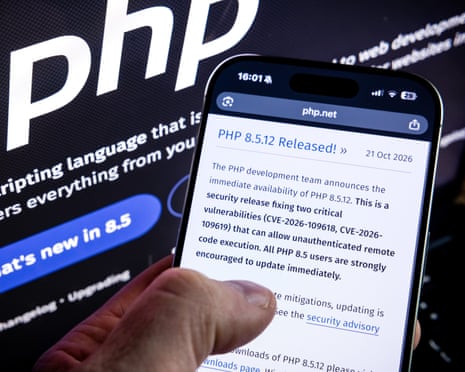
- Vulnerabilities discovered in the programming language PHP could potentially allow hackers to gain control over servers. Photograph: ANP/Shutterstock
- [View image in fullscreen](https://www.theguardian.com/technology/2026/oct/22/what-is-php-computer-language-flaw-causing-global-website-shutdowns#img-1)
- Vulnerabilities discovered in the programming language PHP could potentially allow hackers to gain control over servers. Photograph: ANP/Shutterstock
- [Explainer](https://www.theguardian.com/tone/explainers)
- # What is PHP, and how bad is the computer language flaw causing website shutdowns globally?
- An estimated 70% of websites use the open-source language. What is the identified vulnerability in it?
- Websites across the world have been taken offline in the past day as governments and businesses work to patch [newly discovered vulnerabilities in PHP](https://www.theguardian.com/technology/2026/oct/21/flaw-in-php-computer-language-leads-to-shutdown-of-websites-around-world), a programming language that underpins much of the internet. The exposed flaw would have allowed hackers to carry out cyber-attacks. What were the vulnerabilities and why did they affect so many sites?
- [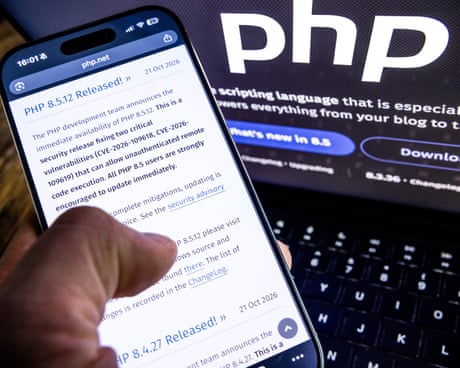\\
- \\
- Flaw in PHP computer language leads to shutdown of websites around world\\
- \\
- Read more](https://www.theguardian.com/technology/2026/oct/21/flaw-in-php-computer-language-leads-to-shutdown-of-websites-around-world)
- * * *
- ## What is PHP?
- PHP is an open-source scripting language that is over 30 years old, and used in much of the internet. Content management systems and publishing template systems such as Wordpress are built on PHP.
- An estimated 70% of websites use PHP, with millions of sites potentially affected by the vulnerabilities. Wikipedia and Facebook are among those.
- Drupal, which is reportedly used as a web platform for many governments around the world, is another service affected by the PHP vulnerabilities. In Australia, for example, 391 government websites use a Drupal-run platform called GovCMS.
- * * *
- ## What is the vulnerability?
- According to [the PHP Foundation](https://thephp.foundation/blog/2026/10/21/todays-php-security-release-and-how-were-strengthening-php-security/), the not-for-profit which maintains PHP code, the issues “sit in parts of PHP that nearly every request touches: memory management and error handling”.
- The two vulnerabilities were dubbed a PHP2Shell exploitation [by security vendor Hadrian](https://hadrian.io/vulnerability-alerts/php2shell-leaked-critical-php-rce-cve-2026-109618-cve-2026-109619).
- The vulnerabilities work by corrupting the memory in a website through a request that can then be used to launch an attack, and could “provide a direct path to the server’s file system or database,” according to the US National Security Agency.
- * * *
- ## How was it discovered?
- Historically, researchers and cybersecurity experts would test systems for vulnerabilities themselves and patch the issues when they are discovered – or patch when one system is attacked and a vulnerability is identified.
- Artificial intelligence has now sped up this process, as AI can be thrown at systems to identify potential issues that might not have been spotted by a human, and can do so in a much shorter time frame.
- The PHP Foundation said it has worked with Anthropic’s frontier model to scan its code, and had PHP put into OpenAI’s Patch the Planet program, which discovered the issue at the same time as a researcher, Ryan A, in mid-August.
- The disclosure of the vulnerabilities had been embargoed until 22 October, to give websites time to fix it. But according to the PHP Foundation, it discovered the two vulnerabilities had begun circulating on forums and social media on Tuesday (UTC time), and so brought forward the disclosure.
- * * *
- ## How bad is it?
- Bad. As the PHP Foundation has said, the issues sit in parts of PHP that nearly every request touches: “Their central place in PHP is what made both vulnerabilities serious, and also so hard to fix without breaking compatibility, hurting performance, or forcing changes on the large ecosystem of third-party extensions.”
- Coupled with the sheer number of sites that rely on PHP, that makes it a massive issue that should be fixed as soon as possible.
- Now the flaw is out in the wild, Hadrian said it was seeing “exploitation happening at scale”.
- * * *
- ## How long will it take to fix?
- Patches are already available, and the reason a number of websites went down in the past day was that people were working to patch their systems immediately. A number of the websites returned quickly.
- Security firms have recommended patching immediately, and where it cannot be done immediately, that systems should be taken offline.
- “Shutting down a service for a few hours costs far less than a compromised server,” Hadrian said.
- However, it will depend on businesses and governments being aware they need to patch, and doing so quickly.
- “The immediate challenge is not simply installing a patch, but finding and managing every instance where PHP is running,” said Don Smith, vice-president of threat intelligence at cybersecurity firm Sophos Counter Threat Unit.
- Sigi Goode, a professor of information systems at the Australian National University, said the sites that went down to fix it were not the problem.
- “The bigger concern is the websites that are not down today. Users should be wary of these, as they are clear targets.”
- * * *
- ## Did someone leak the vulnerability and break embargo?
- It’s unclear whether the vulnerability was leaked ahead of time. A number of security firms did break the embargo after the leak, according to the PHP Foundation, but Amazon Threat Intelligence said in a blog post it had identified a PHP2Shell exploitation attempt dating to four days before the public disclosure.
- “While the vulnerability was under embargo, the targeting of a honeypot from an anonymized IP address suggests the activity was conducted by a threat actor, though it remains unclear how the actor acquired exploit information prior to disclosure,” it said.
- On the day the embargo was due to lift, but before it had lifted, Amazon a
All product names, logos and brands are property of their respective owners. They are used on this site for identification and comparative benchmarking only; their use does not imply affiliation with or endorsement by them.