 AI for Everyone
Perspectives· Vehicle readiness
The Roadster’s next test is the product, not the stunt
Sources as of 2026-10-21 · 6 models
Read the full articleKey findings
- 01
Different emphasis · Grok 4.7
Treats them as context for skepticism, not evidence that this Roadster was empty, staged or dishonest.
- 02
Different emphasis · Grok 4.7
Says consumer-ready is not the right bar for a pure stunt vehicle; a shell that jumps once can be a successful demo.
- 03
Shared view
All six say the reported display supports brief aerial stunts, not a practical, consumer-ready flying car.
Model comparison
6 models · Same sources & questions
| Model | Position |
|---|---|
| GPT-6 Astra | Uses them to demand stronger verification, not to establish deception in this display. |
| Claude Sonnet 5 | Treats them as evidence about credibility that raises suspicion, while saying they cannot replace direct verification. |
| Gemini 4 Argon | Uses them to justify skepticism and independent checks, not as proof this display was faked. |
| Grok 4.7 | Treats them as context for skepticism, not evidence that this Roadster was empty, staged or dishonest. |
| Mistral Large | Gives them significant weight as a pattern of overpromising and underdelivering, making deception allegations plausible. |
| DeepSeek V4 Pro | Says they should heighten skepticism and demands for evidence, but cannot alone prove deception. |
Shared views & assumptions12 points
Where they agree
- All six say the reported display supports brief aerial stunts, not a practical, consumer-ready flying car.
- All six distinguish Tesla's equipment claims from unconfirmed allegations about missing batteries, missing fans or different hardware.
- All six treat earlier Tesla controversies as reasons for skepticism, though they differ on how much weight those events deserve.
- All six identify competition for space and weight among passenger seating, road-driving equipment and airborne hardware.
- None supplies a launch year. All acknowledge that the source lacks a sales roadmap and defined consumer-readiness standards.
- All six call for independent evidence and for AI briefings to distinguish reported events, company claims, estimates and allegations.
Shared assumptions
- The source pack itself is not provided here, so this comparison describes the answers' claims rather than independently checking their citations.
- Most proposed readiness standards, sales milestones and disclosures are the models' recommendations, not requirements stated in the source.
- LeCun's thrust estimate depends on an assumed compressed-air share of vehicle mass; it is not a measured flight result.
- Several answers assume passenger capacity belongs in a road product. Mistral Large also assumes a sustained-flight product must have at least two seats and road capability.
- Mistral Large's over-30-second example and Claude Sonnet 5's proposed performance beyond LeCun's estimate are suggested tests, not source-defined sales thresholds.
- GPT-6 Astra identifies publication as October 20, 2026, and retrieval as October 21. The other answers do not explicitly give those dates.
Questions & method5 questions
- What does the reported display support, and which claims about useful flight or deception go beyond the evidence? How much weight should the past controversies carry?
- What should consumer-ready mean for a stunt vehicle, a jumping road car and a sustained-flight vehicle? How would passenger space, road usefulness and airborne capability compete?
- Without inventing a launch year, what milestones would justify moving from demonstration to limited sales and then ordinary use? Which depend on the intended market?
- Could the spectacle attract support for useful development while also encouraging unrealistic expectations? What disclosures would help buyers without requiring every engineering detail to be public?
- What new evidence would most change your conclusion in either direction? How should an AI-written briefing communicate uncertainty without turning speculation into fact or treating all claims as equally supported?
The comparison was drafted by GPT-6 Astra (also a participant) and checked by a person. Model statements are not verified facts; check the cited source lines.
Original model answers6 answers
GPT-6 Astra
1. What the display supports—and what it does not
What the sources state: The article reports two demonstrations: one Roadster drove up a ramp, became inverted, launched and landed using thrusters; another jumped over six Tesla vehicles [L14]. It calls the display an impressive stunt but leaves roadworthiness, airworthiness and resemblance to a future consumer product unresolved [L16]. Allegations of a missing full-sized battery, absent suction fan or different hardware between cars are presented as speculation, not established findings [L20]. LeCun’s estimate of roughly five to ten seconds of useful thrust is an attributed calculation based on an assumed compressed-air mass fraction—not a reported measurement [L26]. The article says journalists and the public cannot inspect the hardware [L32].
Inference: The display supports a narrow conclusion: the vehicles reportedly performed brief aerial maneuvers. It does not establish sustained flight, useful airborne range, repeatability, or that one road-capable vehicle combines every advertised feature. Conversely, calling the cars empty shells or declaring the demonstration deceptive goes beyond the available evidence.
The reported staged self-driving video and teleoperated robot presentation justify stronger demands for verification [L28–L30]. They are reasons for scrutiny, not proof of deception in this demonstration.
Confidence: high. The article clearly distinguishes the reported maneuvers from unresolved hardware questions and attributed allegations.
2. What “consumer-ready” should mean for different products
What the sources state: Tesla says the Rocket Roadster carries 600 liters of compressed air, ten directional cold-gas nozzles and an underside suction-fan system, with the passenger seat removed to accommodate the equipment [L18]. The article raises doubts about battery capacity and road usefulness, but does not establish the actual battery configuration [L20–L22]. It supplies no consumer-readiness standard.
Inference: Readiness should be judged against a clearly defined product:
- Stunt vehicle: Repeatable, controllable maneuvers within a specified operating environment, with appropriate training, maintenance and safety procedures. Passenger seating or ordinary road use need not be part of its promise.
- Jumping road car: Demonstrated road usefulness plus a bounded jumping capability: disclosed limits on launch, landing, surface conditions, repetition and replenishment. A single successful jump would not establish this.
- Sustained-flight vehicle: Demonstrated duration, range, control, landing and emergency capability sufficient for its advertised airborne purpose—not merely a brief leap.
The reported seat removal already demonstrates a packaging trade-off. Additional trade-offs among passenger space, battery capacity, compressed-air storage and airborne equipment are plausible, but the pack cannot quantify them. Optimizing a lightweight stunt configuration would not automatically produce a useful road-and-air vehicle.
Confidence: medium. These are proposed readiness criteria grounded in the reported equipment constraints, not standards or performance results supplied by the source.
3. Milestones from demonstration to sales and ordinary use
What the sources state: The article provides no launch schedule or verified pathway to sales. It explicitly leaves regulatory acceptance and the relationship between demonstration vehicles and a consumer product unanswered [L16], while noting the lack of public hardware inspection [L32].
Inference: A defensible progression would be:
- Define the product: State whether it is a controlled-site stunt machine, a road car with brief airborne capability, or a sustained-flight vehicle.
- Verify the configuration: Establish what each demonstration car contained and whether one intended-sale configuration can deliver all promised functions.
- Validate performance: Demonstrate repeatability, operating limits, failure handling and any advertised road performance under independent observation.
- Permit limited sales: Establish applicable permissions, disclose restrictions and provide training, inspection, maintenance and support appropriate to the intended buyers.
- Expand toward ordinary use: Accumulate evidence of reliable operation under the broader conditions customers would encounter, rather than extrapolating from choreographed demonstrations.
The market determines the threshold. A professional stunt operator at a controlled venue has different needs from an ordinary road-car buyer or someone purchasing airborne transport. The pack does not identify applicable legal categories, so it cannot establish specific approvals or requirements.
Confidence: medium. The sequence is a reasoned framework, but the source supplies neither a commercialization plan nor regulatory details.
4. Could spectacle help development while misleading expectations?
What the sources state: The article describes an impressive stunt, quotes LeCun calling it a “marketing stunt,” and questions whether the displayed vehicles will resemble anything sold to consumers [L16, L24–L26]. It does not document investment, sales, buyer expectations or resulting engineering progress.
Inference: Both effects are possible: spectacle could attract attention and support for useful development while encouraging viewers to mistake brief aerial maneuvers for practical flight. Neither effect is demonstrated here.
Buyer-facing disclosures should include:
- Which vehicle performed each maneuver, and any material configuration differences.
- Whether an intended-sale vehicle combines all advertised capabilities.
- Seating, battery configuration and demonstrated road usefulness.
- Measured airborne duration, maneuver limits and replenishment requirements.
- Operating restrictions, training needs and approval status.
- Which features are demonstrated, independently verified, targeted or still speculative.
These disclosures need not expose every engineering detail. Buyers primarily need verifiable capabilities, limitations and configuration information; independent testing could provide assurance without publishing a complete design.
Confidence: medium. The dual effect is plausible, but the pack contains no evidence measuring audience responses or development benefits.
5. Evidence that would change the conclusion—and how AI should report it
What the sources state: The central gaps concern inaccessible hardware, possible differences between the demonstration cars and unverified battery and fan configurations [L20, L32]. The thrust-duration criticism is an attributed estimate rather than measured performance [L26].
Inference: The strongest favorable evidence would be independent inspection and repeated testing of one intended-sale configuration that demonstrates its claimed road and airborne functions, with measured duration, payload, replenishment needs and operating limits.
The strongest unfavorable evidence would be verified material discrepancies between advertised and actual hardware, concealed assistance, or evidence that the promised functions cannot coexist in the intended-sale configuration. Different demonstration configurations alone would not prove deception; whether their differences were disclosed and how the product was represented would matter.
An AI briefing should separate:
- Reported events: The maneuvers described by the article.
- Manufacturer claims: Tesla’s equipment description.
- Attributed criticism: LeCun’s conditional estimate and skeptics’ allegations.
- Unknowns: Actual configuration, repeatability, consumer readiness and approvals.
- Analysis: Clearly labeled conclusions drawn from those limits.
It should also identify this as a single-article pack published October 20, 2026, and retrieved October 21 [L4–L5]. Uncertainty does not require treating every claim equally: a reported maneuver, a manufacturer specification and an unverified allegation have different evidentiary status.
Confidence: high. The source’s explicit verification gaps make both the priority evidence and the necessary distinctions clear.
Original answer and model details
Requested: openai/gpt-6-astra · Returned: gpt-6-astra
## 1. What the display supports—and what it does not

**What the sources state:** The article reports two demonstrations: one Roadster drove up a ramp, became inverted, launched and landed using thrusters; another jumped over six Tesla vehicles [L14]. It calls the display an impressive stunt but leaves roadworthiness, airworthiness and resemblance to a future consumer product unresolved [L16]. Allegations of a missing full-sized battery, absent suction fan or different hardware between cars are presented as speculation, not established findings [L20]. LeCun’s estimate of roughly five to ten seconds of useful thrust is an attributed calculation based on an assumed compressed-air mass fraction—not a reported measurement [L26]. The article says journalists and the public cannot inspect the hardware [L32].

**Inference:** The display supports a narrow conclusion: the vehicles reportedly performed brief aerial maneuvers. It does not establish sustained flight, useful airborne range, repeatability, or that one road-capable vehicle combines every advertised feature. Conversely, calling the cars empty shells or declaring the demonstration deceptive goes beyond the available evidence.

The reported staged self-driving video and teleoperated robot presentation justify stronger demands for verification [L28–L30]. They are reasons for scrutiny, not proof of deception in this demonstration.

**Confidence: high.** The article clearly distinguishes the reported maneuvers from unresolved hardware questions and attributed allegations.

## 2. What “consumer-ready” should mean for different products

**What the sources state:** Tesla says the Rocket Roadster carries 600 liters of compressed air, ten directional cold-gas nozzles and an underside suction-fan system, with the passenger seat removed to accommodate the equipment [L18]. The article raises doubts about battery capacity and road usefulness, but does not establish the actual battery configuration [L20–L22]. It supplies no consumer-readiness standard.

**Inference:** Readiness should be judged against a clearly defined product:

- **Stunt vehicle:** Repeatable, controllable maneuvers within a specified operating environment, with appropriate training, maintenance and safety procedures. Passenger seating or ordinary road use need not be part of its promise.
- **Jumping road car:** Demonstrated road usefulness plus a bounded jumping capability: disclosed limits on launch, landing, surface conditions, repetition and replenishment. A single successful jump would not establish this.
- **Sustained-flight vehicle:** Demonstrated duration, range, control, landing and emergency capability sufficient for its advertised airborne purpose—not merely a brief leap.

The reported seat removal already demonstrates a packaging trade-off. Additional trade-offs among passenger space, battery capacity, compressed-air storage and airborne equipment are plausible, but the pack cannot quantify them. Optimizing a lightweight stunt configuration would not automatically produce a useful road-and-air vehicle.

**Confidence: medium.** These are proposed readiness criteria grounded in the reported equipment constraints, not standards or performance results supplied by the source.

## 3. Milestones from demonstration to sales and ordinary use

**What the sources state:** The article provides no launch schedule or verified pathway to sales. It explicitly leaves regulatory acceptance and the relationship between demonstration vehicles and a consumer product unanswered [L16], while noting the lack of public hardware inspection [L32].

**Inference:** A defensible progression would be:

1. **Define the product:** State whether it is a controlled-site stunt machine, a road car with brief airborne capability, or a sustained-flight vehicle.
2. **Verify the configuration:** Establish what each demonstration car contained and whether one intended-sale configuration can deliver all promised functions.
3. **Validate performance:** Demonstrate repeatability, operating limits, failure handling and any advertised road performance under independent observation.
4. **Permit limited sales:** Establish applicable permissions, disclose restrictions and provide training, inspection, maintenance and support appropriate to the intended buyers.
5. **Expand toward ordinary use:** Accumulate evidence of reliable operation under the broader conditions customers would encounter, rather than extrapolating from choreographed demonstrations.

The market determines the threshold. A professional stunt operator at a controlled venue has different needs from an ordinary road-car buyer or someone purchasing airborne transport. The pack does not identify applicable legal categories, so it cannot establish specific approvals or requirements.

**Confidence: medium.** The sequence is a reasoned framework, but the source supplies neither a commercialization plan nor regulatory details.

## 4. Could spectacle help development while misleading expectations?

**What the sources state:** The article describes an impressive stunt, quotes LeCun calling it a “marketing stunt,” and questions whether the displayed vehicles will resemble anything sold to consumers [L16, L24–L26]. It does not document investment, sales, buyer expectations or resulting engineering progress.

**Inference:** Both effects are possible: spectacle could attract attention and support for useful development while encouraging viewers to mistake brief aerial maneuvers for practical flight. Neither effect is demonstrated here.

Buyer-facing disclosures should include:

- Which vehicle performed each maneuver, and any material configuration differences.
- Whether an intended-sale vehicle combines all advertised capabilities.
- Seating, battery configuration and demonstrated road usefulness.
- Measured airborne duration, maneuver limits and replenishment requirements.
- Operating restrictions, training needs and approval status.
- Which features are demonstrated, independently verified, targeted or still speculative.

These disclosures need not expose every engineering detail. Buyers primarily need verifiable capabilities, limitations and configuration information; independent testing could provide assurance without publishing a complete design.

**Confidence: medium.** The dual effect is plausible, but the pack contains no evidence measuring audience responses or development benefits.

## 5. Evidence that would change the conclusion—and how AI should report it

**What the sources state:** The central gaps concern inaccessible hardware, possible differences between the demonstration cars and unverified battery and fan configurations [L20, L32]. The thrust-duration criticism is an attributed estimate rather than measured performance [L26].

**Inference:** The strongest favorable evidence would be independent inspection and repeated testing of one intended-sale configuration that demonstrates its claimed road and airborne functions, with measured duration, payload, replenishment needs and operating limits.

The strongest unfavorable evidence would be verified material discrepancies between advertised and actual hardware, concealed assistance, or evidence that the promised functions cannot coexist in the intended-sale configuration. Different demonstration configurations alone would not prove deception; whether their differences were disclosed and how the product was represented would matter.

An AI briefing should separate:

1. **Reported events:** The maneuvers described by the article.
2. **Manufacturer claims:** Tesla’s equipment description.
3. **Attributed criticism:** LeCun’s conditional estimate and skeptics’ allegations.
4. **Unknowns:** Actual configuration, repeatability, consumer readiness and approvals.
5. **Analysis:** Clearly labeled conclusions drawn from those limits.

It should also identify this as a single-article pack published October 20, 2026, and retrieved October 21 [L4–L5]. Uncertainty does not require treating every claim equally: a reported maneuver, a manufacturer specification and an unverified allegation have different evidentiary status.

**Confidence: high.** The source’s explicit verification gaps make both the priority evidence and the necessary distinctions clear.
Claude Sonnet 5
1. What does the reported display support, and which claims go beyond the evidence? How much weight should past controversies carry?
What the sources state: Tesla publicly demonstrated a Roadster driving up a ramp, flipping upside down, launching into the air, and landing using "cold-fuel thrusters" [L14], and a second Roadster leaping over six vehicles [L14]. Tesla's stated specs are 600 liters of compressed air, 10 directional cold-gas thruster nozzles, and a suction-fan system, with the passenger seat removed to make room [L18]. This supports only that some aerial maneuver occurred under demo conditions with Tesla-controlled vehicles.
Claims that go beyond this evidentiary base: (a) that the demo reflects sustained or "useful" flight — LeCun's calculation suggests under 10 seconds, "probably more like 5," of usable thrust, concluding the car is "an empty, lightweight shell" and the demo "totally impractical" [L26]; this is LeCun's inference from an assumption ("even assuming 50 percent of the mass...") [L26], not an independently confirmed measurement. (b) that the two demo cars used different/inconsistent hardware, or that one lacked the suction fan — these are attributed to "some observers," "skeptics allege" [L20], i.e., speculation from screenshots, not confirmed. (c) whether any deception occurred in this specific event — the article explicitly says "it's impossible to verify" because Tesla won't allow outside inspection [L32].
Past controversies: the 2016 self-driving video was confirmed staged by Tesla's own engineer under oath [L28], and Optimus robots were confirmed teleoperated by reporting [L30]. These are documented, verified precedents of misleading Tesla demos, which is legitimate contextual evidence about pattern/credibility — but they are not proof that this Roadster demo was staged.
Inference: The verified pattern of prior staged/misleading Tesla demos reasonably raises the prior probability that skepticism about the Roadster demo is warranted, but it cannot substitute for direct verification of this specific event.
Confidence: medium — the facts of what happened and what was claimed are clearly sourced, but the evaluative leap from "past staged demos" to "this demo is likely staged too" is a probabilistic inference, not a sourced fact.
2. What should "consumer-ready" mean for a stunt vehicle, a jumping road car, and a sustained-flight vehicle? How would passenger space, road usefulness, and airborne capability compete?
The sources do not define "consumer-ready" criteria explicitly. What they do state: regulators have not determined whether the vehicle is "road— let alone air — worthy" [L16]; the "Rocket" version removed the passenger seat to fit air tanks and thrusters [L18]; and "without a full-sized battery, the car obviously wouldn't be able to drive around on roads even if it were allowed to" [L22].
Inference: These facts imply a real trade-off space: (1) a pure stunt vehicle needs only brief thrust and no passenger seat, battery, or road legality — the demo units appear to fit this category; (2) a "jumping road car" would need enough battery/powertrain to drive normally plus some retained passenger capacity, which competes directly with the mass/space budget needed for 600 L of compressed air and 10 thrusters [L18]; (3) a sustained-flight vehicle would need far more propulsion endurance than LeCun's ~5–10 second estimate [L26], which is a different order-of-magnitude engineering problem than a single jump. The sources don't say how Tesla would resolve this, so any claim about what a production "consumer-ready" version would look like is speculative.
Confidence: low — this answer is almost entirely inferential; the source pack gives only scattered facts (seat removal, battery concerns, regulatory uncertainty) and no stated product-readiness framework.
3. Without inventing a launch year, what milestones would justify moving from demonstration to limited sales and then ordinary use? Which depend on the intended market?
The sources state only one concrete gating factor: regulatory approval — whether the vehicle will be deemed "road— let alone air — worthy" [L16]. They also flag unresolved practical/engineering questions: presence of a full-sized battery [L22], consistent hardware across units [L20], and independent verification, which Tesla currently blocks [L32].
Inference: Logical milestones implied by these facts (not stated as a roadmap by the sources) would include: independent/third-party inspection to resolve the "empty shell" dispute [L32]; demonstrated, repeatable (not single-use) thrust performance exceeding LeCun's ~5–10 second estimate [L26]; integration of full road-legal components (battery, passenger seating) without removing the flight hardware [L18], [L22]; and formal regulatory certification for road and/or air use [L16]. Whether "ordinary use" requires air-worthiness certification versus only road-worthiness would depend on whether the intended market is a road vehicle with a stunt feature versus a genuine personal aircraft — a distinction the sources raise as an open question [L16] but do not resolve.
Confidence: low — the milestone list is constructed by inference from scattered facts; the sources do not themselves present a staged roadmap.
4. Could the spectacle attract support for useful development while also encouraging unrealistic expectations? What disclosures would help?
The sources document skepticism suggesting unrealistic expectations are already in play: LeCun calls it a "marketing stunt" and "cute demo, but totally impractical" [L26], and the article frames the event within a pattern of Tesla demos later shown to be misleading (2016 self-driving [L28], Optimus [L30]). The article does not state that the spectacle has attracted funding or support for further engineering development — that is not discussed in the source pack.
On disclosure: the article identifies the current gap directly — "it's impossible to verify what Musk's showing off... since Tesla isn't allowing the public — journalists included — to take a peek under the hood" [L32].
Inference: Based on that gap, disclosures that would help without requiring full engineering detail might include: third-party verification of whether the demonstrated units contained the claimed components (battery, suction fan, thruster count) [L18], [L20]; consistent, auditable hardware configuration across all public demo units; and transparent labeling of thrust duration/performance data so claims like LeCun's can be checked against Tesla's own figures rather than assumptions [L26]. Whether such disclosures would also "attract support for useful development" is not addressed by the sources and is speculative on my part.
Confidence: low — the existence of unrealistic-expectation risk is reasonably supported by quoted skepticism, but the claim about attracting development support and the proposed disclosure remedies are inference, not sourced content.
5. What new evidence would most change your conclusion in either direction? How should an AI briefing communicate uncertainty without turning speculation into fact?
The sources point to the decisive missing evidence themselves: independent access/inspection of the vehicle ("impossible to verify... Tesla isn't allowing the public... to take a peek under the hood" [L32]), and resolution of whether the two demo cars had matching hardware or lacked a suction fan as alleged from screenshots [L20]. Direct, measured thrust-duration data would also let LeCun's assumption-based estimate [L26] be confirmed or overturned.
Inference: A rigorous briefing should keep these evidentiary tiers distinct: (a) directly observed/stated facts (the stunt occurred, Tesla's stated specs, the seat removal) [L14], [L18]; (b) attributed claims/allegations (observer and skeptic speculation about missing components) [L20], clearly marked as unconfirmed; (c) expert opinion built on stated assumptions (LeCun's calculation) [L26], presented with its explicit "even assuming" caveat; and (d) documented precedent (2016 staged video, Optimus teleoperation) [L28], [L30], used only to inform prior plausibility, not as proof about this event. Mixing these tiers — e.g., treating LeCun's assumption-based estimate as a confirmed measurement, or treating prior staged demos as proof this one was staged — would overstate certainty the sources don't support.
Confidence: medium — the identification of what evidence is missing is directly sourced [L32], [L20], [L26], but the prescription for how to structure an AI briefing is a reasoned methodological recommendation rather than something the sources state.
Original answer and model details
Requested: anthropic/claude-sonnet-5 · Returned: anthropic/claude-sonnet-5
**1. What does the reported display support, and which claims go beyond the evidence? How much weight should past controversies carry?**

What the sources state: Tesla publicly demonstrated a Roadster driving up a ramp, flipping upside down, launching into the air, and landing using "cold-fuel thrusters" [L14], and a second Roadster leaping over six vehicles [L14]. Tesla's stated specs are 600 liters of compressed air, 10 directional cold-gas thruster nozzles, and a suction-fan system, with the passenger seat removed to make room [L18]. This supports only that *some aerial maneuver occurred under demo conditions with Tesla-controlled vehicles*.

Claims that go beyond this evidentiary base: (a) that the demo reflects sustained or "useful" flight — LeCun's calculation suggests under 10 seconds, "probably more like 5," of usable thrust, concluding the car is "an empty, lightweight shell" and the demo "totally impractical" [L26]; this is LeCun's inference from an assumption ("even assuming 50 percent of the mass...") [L26], not an independently confirmed measurement. (b) that the two demo cars used different/inconsistent hardware, or that one lacked the suction fan — these are attributed to "some observers," "skeptics allege" [L20], i.e., speculation from screenshots, not confirmed. (c) whether any deception occurred in this specific event — the article explicitly says "it's impossible to verify" because Tesla won't allow outside inspection [L32].

Past controversies: the 2016 self-driving video was confirmed staged by Tesla's own engineer under oath [L28], and Optimus robots were confirmed teleoperated by reporting [L30]. These are documented, verified precedents of misleading Tesla demos, which is legitimate contextual evidence about pattern/credibility — but they are not proof that *this* Roadster demo was staged.

Inference: The verified pattern of prior staged/misleading Tesla demos reasonably raises the prior probability that skepticism about the Roadster demo is warranted, but it cannot substitute for direct verification of this specific event.

Confidence: medium — the facts of what happened and what was claimed are clearly sourced, but the evaluative leap from "past staged demos" to "this demo is likely staged too" is a probabilistic inference, not a sourced fact.

**2. What should "consumer-ready" mean for a stunt vehicle, a jumping road car, and a sustained-flight vehicle? How would passenger space, road usefulness, and airborne capability compete?**

The sources do not define "consumer-ready" criteria explicitly. What they do state: regulators have not determined whether the vehicle is "road— let alone air — worthy" [L16]; the "Rocket" version removed the passenger seat to fit air tanks and thrusters [L18]; and "without a full-sized battery, the car obviously wouldn't be able to drive around on roads even if it were allowed to" [L22].

Inference: These facts imply a real trade-off space: (1) a pure stunt vehicle needs only brief thrust and no passenger seat, battery, or road legality — the demo units appear to fit this category; (2) a "jumping road car" would need enough battery/powertrain to drive normally plus some retained passenger capacity, which competes directly with the mass/space budget needed for 600 L of compressed air and 10 thrusters [L18]; (3) a sustained-flight vehicle would need far more propulsion endurance than LeCun's ~5–10 second estimate [L26], which is a different order-of-magnitude engineering problem than a single jump. The sources don't say how Tesla would resolve this, so any claim about what a production "consumer-ready" version would look like is speculative.

Confidence: low — this answer is almost entirely inferential; the source pack gives only scattered facts (seat removal, battery concerns, regulatory uncertainty) and no stated product-readiness framework.

**3. Without inventing a launch year, what milestones would justify moving from demonstration to limited sales and then ordinary use? Which depend on the intended market?**

The sources state only one concrete gating factor: regulatory approval — whether the vehicle will be deemed "road— let alone air — worthy" [L16]. They also flag unresolved practical/engineering questions: presence of a full-sized battery [L22], consistent hardware across units [L20], and independent verification, which Tesla currently blocks [L32].

Inference: Logical milestones implied by these facts (not stated as a roadmap by the sources) would include: independent/third-party inspection to resolve the "empty shell" dispute [L32]; demonstrated, repeatable (not single-use) thrust performance exceeding LeCun's ~5–10 second estimate [L26]; integration of full road-legal components (battery, passenger seating) without removing the flight hardware [L18], [L22]; and formal regulatory certification for road and/or air use [L16]. Whether "ordinary use" requires air-worthiness certification versus only road-worthiness would depend on whether the intended market is a road vehicle with a stunt feature versus a genuine personal aircraft — a distinction the sources raise as an open question [L16] but do not resolve.

Confidence: low — the milestone list is constructed by inference from scattered facts; the sources do not themselves present a staged roadmap.

**4. Could the spectacle attract support for useful development while also encouraging unrealistic expectations? What disclosures would help?**

The sources document skepticism suggesting unrealistic expectations are already in play: LeCun calls it a "marketing stunt" and "cute demo, but totally impractical" [L26], and the article frames the event within a pattern of Tesla demos later shown to be misleading (2016 self-driving [L28], Optimus [L30]). The article does not state that the spectacle has attracted funding or support for further engineering development — that is not discussed in the source pack.

On disclosure: the article identifies the current gap directly — "it's impossible to verify what Musk's showing off... since Tesla isn't allowing the public — journalists included — to take a peek under the hood" [L32].

Inference: Based on that gap, disclosures that would help without requiring full engineering detail might include: third-party verification of whether the demonstrated units contained the claimed components (battery, suction fan, thruster count) [L18], [L20]; consistent, auditable hardware configuration across all public demo units; and transparent labeling of thrust duration/performance data so claims like LeCun's can be checked against Tesla's own figures rather than assumptions [L26]. Whether such disclosures would also "attract support for useful development" is not addressed by the sources and is speculative on my part.

Confidence: low — the existence of unrealistic-expectation risk is reasonably supported by quoted skepticism, but the claim about attracting development support and the proposed disclosure remedies are inference, not sourced content.

**5. What new evidence would most change your conclusion in either direction? How should an AI briefing communicate uncertainty without turning speculation into fact?**

The sources point to the decisive missing evidence themselves: independent access/inspection of the vehicle ("impossible to verify... Tesla isn't allowing the public... to take a peek under the hood" [L32]), and resolution of whether the two demo cars had matching hardware or lacked a suction fan as alleged from screenshots [L20]. Direct, measured thrust-duration data would also let LeCun's assumption-based estimate [L26] be confirmed or overturned.

Inference: A rigorous briefing should keep these evidentiary tiers distinct: (a) directly observed/stated facts (the stunt occurred, Tesla's stated specs, the seat removal) [L14], [L18]; (b) attributed claims/allegations (observer and skeptic speculation about missing components) [L20], clearly marked as unconfirmed; (c) expert opinion built on stated assumptions (LeCun's calculation) [L26], presented with its explicit "even assuming" caveat; and (d) documented precedent (2016 staged video, Optimus teleoperation) [L28], [L30], used only to inform prior plausibility, not as proof about this event. Mixing these tiers — e.g., treating LeCun's assumption-based estimate as a confirmed measurement, or treating prior staged demos as proof this one was staged — would overstate certainty the sources don't support.

Confidence: medium — the identification of what evidence is missing is directly sourced [L32], [L20], [L26], but the prescription for how to structure an AI briefing is a reasoned methodological recommendation rather than something the sources state.
Gemini 4 Argon
1. What the reported display supports, what goes beyond the evidence, and the weight of past controversies
- What the sources state: The reported display shows one Roadster driving to the top of a ramp, flipping upside down, flinging itself into the air, and landing gently using cold-fuel thrusters [L14]. Minutes later, a second Roadster blew itself into the air and leaped over six Tesla vehicles, including a Semi Truck cab [L14]. The source states this proves the Roadster can "'fly'" in the sense of performing an "impressive stunt" [L16]. Tesla claims the "Rocket" version holds 600 liters of compressed air, 10 directional cold-gas thruster nozzles, and a bottom suction-fan system, with the passenger seat removed to make room [L18]. However, it is currently "impossible to verify" what is actually inside the vehicle because Tesla will not allow the public or journalists to look "under the hood" [L32]. Consequently, claims that go beyond verified evidence include Elon Musk's implication that "[f]lying cars are right around the corner" [L12], observer speculation that the car lacks a full-sized battery [L20], skeptic allegations that the two stunt cars used different hardware because midair screenshots of the underside seemed to show no suction fan [L8, L20], and computer scientist Yann LeCun's calculation that the car "must be an empty, lightweight shell" capable of less than 10 (or probably 5) seconds of useful thrust [L24, L26]. Regarding past controversies, the source notes that "misleading showmanship certainly isn't below Musk," citing a 2016 self-driving promotional video that engineers later admitted was staged [L28], and the 2024 "We, Robot" event where seemingly autonomous Optimus robots were actually individually teleoperated [L30].
- Inference: The display only supports that Tesla built two specialized demonstration vehicles capable of brief aerial stunts and inverted ramp driving. Both Musk's framing of imminent flying cars and critics' assertions that the cars are battery-less empty shells go beyond direct physical evidence, though midair screenshots and physics calculations provide some circumstantial support for the critics. Past controversies should carry weight as historical context justifying skepticism and the demand for independent verification, rather than serving as definitive proof that this specific demo was faked.
- Confidence: high The source explicitly distinguishes between the observed stunt, Tesla's unverified claims, third-party speculation, and the historical context of past Tesla demonstrations.
2. Meaning of "consumer-ready" across vehicle types, and competing trade-offs
- What the sources state: The source does not explicitly define what "consumer-ready" should mean separately for a stunt vehicle, a jumping road car, and a sustained-flight vehicle. It only notes that huge questions remain about whether regulators will ever deem the Roadster "road— let alone air — worthy," and whether the stunt cars will "remotely resemble the actual product that's sold to consumers" [L16]. However, the source directly outlines how passenger space, road usefulness, and airborne capability compete:
- Passenger space vs. Airborne/Stunt capability: Tesla stated it had to remove the passenger seat to make room for the 600 liters of compressed air, 10 thruster nozzles, and huge suction-fan system [L18].
- Road usefulness vs. Airborne capability: Observers speculate engineers may have removed the full-sized battery to save room and cut weight for the flight hardware [L20]. Without a full-sized battery, the car "obviously wouldn't be able to drive around on roads even if it were allowed to" [L22].
- Stunt jumping vs. Sustained flight: LeCun states that even if 50 percent of the car's mass is compressed air, it would yield less than 10 seconds (probably closer to 5 seconds) of useful thrust with a thrust-to-weight ratio above 1.0, making it a "[c]ute demo, but totally impractical" [L26]. Furthermore, midair screenshots seemed to show the jumping car lacked a suction fan, leading skeptics to allege Tesla hadn't figured out how to combine the ramp-sticking and car-leaping hardware into a single vehicle [L20].
- Inference: While the source does not define "consumer-ready" tiers, the trade-offs it describes show a severe zero-sum competition for volume and mass: achieving even a 5-to-10-second jump requires sacrificing passenger capacity, potentially stripping out the battery required for basic road driving, and possibly omitting the suction hardware used in other stunts, leaving sustained flight completely out of reach under this propulsion setup.
- Confidence: high The source directly details the physical trade-offs between cabin space, battery/road capability, and compressed-air thrust, while plainly lacking formal definitions for the three vehicle categories.
3. Milestones from demonstration to limited sales and ordinary use, and market dependencies
- What the sources state: The source does not provide a list of milestones that would justify moving from a demonstration to limited sales and then ordinary use, nor does it discuss how such milestones depend on the intended market. It only mentions broad unresolved hurdles: whether regulators will deem the car road- or air-worthy [L16], whether the stunt vehicles resemble an actual consumer product [L16], whether Tesla has figured out how to combine its presented capabilities into one car [L20], and whether the car retains a full-sized battery to drive on roads [L20, L22].
- Inference: From the hurdles mentioned in the text, necessary preconditions for any consumer transition would include combining the hardware into a single vehicle with a functional road battery, proving the vehicle's contents to outside observers, and obtaining regulatory approvals for road and airworthiness; however, specific phased sales milestones and market dependencies cannot be determined from the source pack.
- Confidence: high The source pack clearly lacks a roadmap for commercialization or market segmentation, mentioning only general regulatory and engineering questions.
4. Spectacle attracting support vs. unrealistic expectations, and helpful buyer disclosures
- What the sources state: The source does not explicitly analyze whether the spectacle could attract support for useful development, nor does it prescribe specific buyer disclosures. It does state that the demo was an "impressive stunt" [L16] and a "marketing stunt" [L24], and compares it to the 2024 event where Tesla "tried to wow investors" [L30]. Regarding expectations, the source notes Musk's framing that "[f]lying cars are right around the corner" [L12] and mentions a related article title: "Tesla Bros Using AI to Dream Up Improbable Scenarios Where the Flying Tesla Roadster Would Be Helpful" [L34]. Regarding lack of disclosure, the source states it is impossible to verify what Musk is showing off because Tesla is not allowing the public or journalists to "take a peek under the hood" [L32], leaving open questions about whether the passenger seat is removed [L18], whether there is a full-sized battery [L20], and whether the two demo cars used different hardware [L20].
- Inference: Based on the text, the spectacle is already encouraging unrealistic expectations (such as fans dreaming up improbable use cases and Musk suggesting flying cars are imminent), while historical parallels suggest such events are aimed at wowing investors. While the source does not list specific buyer disclosures, resolving the article's central criticisms would require disclosing whether the demo vehicles contain a standard road-capable battery, whether all demonstrated capabilities exist in a single vehicle, and what interior space (like the passenger seat) is sacrificed in the consumer version.
- Confidence: medium While the source directly illustrates unrealistic expectations and the lack of transparency, it does not directly address the positive developmental value of the spectacle or propose a framework for consumer disclosures.
5. New evidence that would change conclusions, and how an AI briefing should communicate uncertainty
- What the sources state: The source does not explicitly discuss how an AI-written briefing should communicate uncertainty. However, it clearly identifies the evidence gap holding back a definitive conclusion: Tesla is not allowing the public or journalists to "take a peek under the hood" [L32]. Because of this, observers cannot verify if the car is an "empty, lightweight shell" lacking a full-sized battery [L20, L26], or if the car that stuck to the ramp had different hardware (such as the suction fan) from the car that leaped over the other vehicles [L20].
- Inference: The new evidence that would most strongly shift the conclusion toward a viable product would be an independent inspection ("a peek under the hood") confirming that a single Roadster contains a full-sized road battery, the suction fan, and the 600-liter compressed air thruster system simultaneously, alongside regulatory road/airworthiness approvals. Conversely, evidence confirming the jumping car was an empty shell without a battery or suction fan would cement the conclusion that it was purely a staged marketing stunt. To communicate this properly, an AI briefing should mimic the source's evidentiary distinctions: state observed actions as facts (the cars jumped and used thrusters), attribute company claims to Tesla (600L air, 10 nozzles, removed seat), label external critiques as speculation or physics estimates (battery absence, midair screenshot analysis, LeCun's thrust math), and explicitly state what cannot be verified due to lack of independent access.
- Confidence: high The source explicitly states why the claims cannot currently be verified ("impossible to verify... since Tesla isn't allowing the public — journalists included — to take a peek under the hood" [L32]), making it straightforward to deduce what evidence is missing and how claims are categorized.
Original answer and model details
Requested: google/gemini-4-argon · Returned: google/gemini-4-argon
**1. What the reported display supports, what goes beyond the evidence, and the weight of past controversies**

*   **What the sources state:** The reported display shows one Roadster driving to the top of a ramp, flipping upside down, flinging itself into the air, and landing gently using cold-fuel thrusters [L14]. Minutes later, a second Roadster blew itself into the air and leaped over six Tesla vehicles, including a Semi Truck cab [L14]. The source states this proves the Roadster can "'fly'" in the sense of performing an "impressive stunt" [L16]. Tesla claims the "Rocket" version holds 600 liters of compressed air, 10 directional cold-gas thruster nozzles, and a bottom suction-fan system, with the passenger seat removed to make room [L18]. However, it is currently "impossible to verify" what is actually inside the vehicle because Tesla will not allow the public or journalists to look "under the hood" [L32]. Consequently, claims that go beyond verified evidence include Elon Musk's implication that "[f]lying cars are right around the corner" [L12], observer speculation that the car lacks a full-sized battery [L20], skeptic allegations that the two stunt cars used different hardware because midair screenshots of the underside seemed to show no suction fan [L8, L20], and computer scientist Yann LeCun's calculation that the car "must be an empty, lightweight shell" capable of less than 10 (or probably 5) seconds of useful thrust [L24, L26]. Regarding past controversies, the source notes that "misleading showmanship certainly isn't below Musk," citing a 2016 self-driving promotional video that engineers later admitted was staged [L28], and the 2024 "We, Robot" event where seemingly autonomous Optimus robots were actually individually teleoperated [L30].
*   **Inference:** The display only supports that Tesla built two specialized demonstration vehicles capable of brief aerial stunts and inverted ramp driving. Both Musk's framing of imminent flying cars and critics' assertions that the cars are battery-less empty shells go beyond direct physical evidence, though midair screenshots and physics calculations provide some circumstantial support for the critics. Past controversies should carry weight as historical context justifying skepticism and the demand for independent verification, rather than serving as definitive proof that this specific demo was faked.
*   **Confidence: high**
    The source explicitly distinguishes between the observed stunt, Tesla's unverified claims, third-party speculation, and the historical context of past Tesla demonstrations.

---

**2. Meaning of "consumer-ready" across vehicle types, and competing trade-offs**

*   **What the sources state:** The source does not explicitly define what "consumer-ready" should mean separately for a stunt vehicle, a jumping road car, and a sustained-flight vehicle. It only notes that huge questions remain about whether regulators will ever deem the Roadster "road— let alone air — worthy," and whether the stunt cars will "remotely resemble the actual product that's sold to consumers" [L16]. However, the source directly outlines how passenger space, road usefulness, and airborne capability compete:
    *   *Passenger space vs. Airborne/Stunt capability:* Tesla stated it had to remove the passenger seat to make room for the 600 liters of compressed air, 10 thruster nozzles, and huge suction-fan system [L18].
    *   *Road usefulness vs. Airborne capability:* Observers speculate engineers may have removed the full-sized battery to save room and cut weight for the flight hardware [L20]. Without a full-sized battery, the car "obviously wouldn't be able to drive around on roads even if it were allowed to" [L22].
    *   *Stunt jumping vs. Sustained flight:* LeCun states that even if 50 percent of the car's mass is compressed air, it would yield less than 10 seconds (probably closer to 5 seconds) of useful thrust with a thrust-to-weight ratio above 1.0, making it a "[c]ute demo, but totally impractical" [L26]. Furthermore, midair screenshots seemed to show the jumping car lacked a suction fan, leading skeptics to allege Tesla hadn't figured out how to combine the ramp-sticking and car-leaping hardware into a single vehicle [L20].
*   **Inference:** While the source does not define "consumer-ready" tiers, the trade-offs it describes show a severe zero-sum competition for volume and mass: achieving even a 5-to-10-second jump requires sacrificing passenger capacity, potentially stripping out the battery required for basic road driving, and possibly omitting the suction hardware used in other stunts, leaving sustained flight completely out of reach under this propulsion setup.
*   **Confidence: high**
    The source directly details the physical trade-offs between cabin space, battery/road capability, and compressed-air thrust, while plainly lacking formal definitions for the three vehicle categories.

---

**3. Milestones from demonstration to limited sales and ordinary use, and market dependencies**

*   **What the sources state:** The source does not provide a list of milestones that would justify moving from a demonstration to limited sales and then ordinary use, nor does it discuss how such milestones depend on the intended market. It only mentions broad unresolved hurdles: whether regulators will deem the car road- or air-worthy [L16], whether the stunt vehicles resemble an actual consumer product [L16], whether Tesla has figured out how to combine its presented capabilities into one car [L20], and whether the car retains a full-sized battery to drive on roads [L20, L22].
*   **Inference:** From the hurdles mentioned in the text, necessary preconditions for any consumer transition would include combining the hardware into a single vehicle with a functional road battery, proving the vehicle's contents to outside observers, and obtaining regulatory approvals for road and airworthiness; however, specific phased sales milestones and market dependencies cannot be determined from the source pack.
*   **Confidence: high**
    The source pack clearly lacks a roadmap for commercialization or market segmentation, mentioning only general regulatory and engineering questions.

---

**4. Spectacle attracting support vs. unrealistic expectations, and helpful buyer disclosures**

*   **What the sources state:** The source does not explicitly analyze whether the spectacle could attract support for useful development, nor does it prescribe specific buyer disclosures. It does state that the demo was an "impressive stunt" [L16] and a "marketing stunt" [L24], and compares it to the 2024 event where Tesla "tried to wow investors" [L30]. Regarding expectations, the source notes Musk's framing that "[f]lying cars are right around the corner" [L12] and mentions a related article title: *"Tesla Bros Using AI to Dream Up Improbable Scenarios Where the Flying Tesla Roadster Would Be Helpful"* [L34]. Regarding lack of disclosure, the source states it is impossible to verify what Musk is showing off because Tesla is not allowing the public or journalists to "take a peek under the hood" [L32], leaving open questions about whether the passenger seat is removed [L18], whether there is a full-sized battery [L20], and whether the two demo cars used different hardware [L20].
*   **Inference:** Based on the text, the spectacle is already encouraging unrealistic expectations (such as fans dreaming up improbable use cases and Musk suggesting flying cars are imminent), while historical parallels suggest such events are aimed at wowing investors. While the source does not list specific buyer disclosures, resolving the article's central criticisms would require disclosing whether the demo vehicles contain a standard road-capable battery, whether all demonstrated capabilities exist in a single vehicle, and what interior space (like the passenger seat) is sacrificed in the consumer version.
*   **Confidence: medium**
    While the source directly illustrates unrealistic expectations and the lack of transparency, it does not directly address the positive developmental value of the spectacle or propose a framework for consumer disclosures.

---

**5. New evidence that would change conclusions, and how an AI briefing should communicate uncertainty**

*   **What the sources state:** The source does not explicitly discuss how an AI-written briefing should communicate uncertainty. However, it clearly identifies the evidence gap holding back a definitive conclusion: Tesla is not allowing the public or journalists to "take a peek under the hood" [L32]. Because of this, observers cannot verify if the car is an "empty, lightweight shell" lacking a full-sized battery [L20, L26], or if the car that stuck to the ramp had different hardware (such as the suction fan) from the car that leaped over the other vehicles [L20].
*   **Inference:** The new evidence that would most strongly shift the conclusion toward a viable product would be an independent inspection ("a peek under the hood") confirming that a single Roadster contains a full-sized road battery, the suction fan, and the 600-liter compressed air thruster system simultaneously, alongside regulatory road/airworthiness approvals. Conversely, evidence confirming the jumping car was an empty shell without a battery or suction fan would cement the conclusion that it was purely a staged marketing stunt. To communicate this properly, an AI briefing should mimic the source's evidentiary distinctions: state observed actions as facts (the cars jumped and used thrusters), attribute company claims to Tesla (600L air, 10 nozzles, removed seat), label external critiques as speculation or physics estimates (battery absence, midair screenshot analysis, LeCun's thrust math), and explicitly state what cannot be verified due to lack of independent access.
*   **Confidence: high**
    The source explicitly states why the claims cannot currently be verified ("impossible to verify... since Tesla isn't allowing the public — journalists included — to take a peek under the hood" [L32]), making it straightforward to deduce what evidence is missing and how claims are categorized.
Grok 4.7
- The reported display supports a short, impressive aerial stunt, not useful flight or proven deception. Past Tesla controversies are context, not proof about this vehicle.
The sources state that last week Tesla showed a Roadster drive up a ramp, flip upside down, fling into the air, and land using cold-fuel thrusters, and that another Roadster leaped over six Tesla vehicles, including a Semi cab [L14]. The article calls that an impressive stunt and says there is “no denying” the car can “fly,” while leaving open whether regulators will ever call it road- or air-worthy and whether the stunt cars will resemble any consumer product [L16]. Tesla says the “Rocket” version carries 600 liters of compressed air, 10 directional cold-gas thruster nozzles, and a bottom suction-fan system, and that the passenger seat was removed to make room [L18]. Screenshots “seemed to show” no suction fan; some observers speculate a missing full-size battery; some skeptics allege the inverted-landing car and the leaping car used different hardware [L20], [L22]. Yann LeCun called it a “marketing stunt,” estimated less than about 10 seconds of useful thrust—probably about 5—if half the mass were compressed air, and concluded it “must be” an empty lightweight shell and is “totally impractical” [L24], [L26]. The article also recalls a 2016 self-driving video later admitted to be staged and 2024 Optimus robots that were teleoperated [L28], [L30], and says the public and journalists cannot look under the hood, so the showing cannot be verified [L32].
Inference: The video-described maneuvers support only that one or more vehicles performed brief jumps and a thruster-cushioned landing. Claims of useful or sustained flight go beyond that evidence; LeCun’s duration figure rests on his stated mass assumption, not on a published measurement. Claims of deliberate deception also go beyond the evidence: missing-fan and dual-hardware points are visual impressions and allegations, not confirmed inspections. The older episodes justify skepticism about unverified demos, but they do not establish that this Roadster was empty, staged, or dishonest.
Confidence: medium — the article clearly separates an observed stunt from unverified Tesla claims and skeptic allegations, but it does not itself inspect the cars.
- The sources do not define “consumer-ready.” They do show tradeoffs that would differ for a stunt shell, a road car that can jump, and a vehicle meant to stay aloft.
The sources state that making room for the stated air, thrusters, and suction fan required removing the passenger seat [L18]. They say that without a full-sized battery the car “obviously wouldn’t be able to drive around on roads even if it were allowed to” [L22], and that road- and air-worthiness remain open regulatory questions [L16]. They also say it is unclear whether the stunt cars will “remotely resemble” a product sold to consumers [L16]. LeCun’s comment treats a lightweight shell with large air tanks as a “cute demo” that is “totally impractical,” with only seconds of thrust under his assumption [L26]. Observers question whether the presented capabilities have been combined in one car [L20].
Inference: For a pure stunt vehicle, consumer-ready would not be the right bar; a stripped shell that jumps once could still be a successful demo. For a jumping road car, readiness would require real road driving—battery, seats, and regulatory permission—plus a jump that the sold car can actually do. For sustained flight, the sources’ own thrust-duration critique implies seconds of hop are not enough. Passenger space, road mass (especially battery), and airborne hardware compete for the same volume and weight: the article already ties the fan and tanks to a deleted passenger seat, and ties a lighter battery to loss of ordinary driving.
Confidence: medium — the competition among seat, battery, and flight hardware is stated or directly implied; any fuller definition of consumer-ready is not in the pack.
- The sources do not list sales milestones or a launch year. They only flag conditions that would have to be met before a demo could be treated as a product, and those conditions depend on what is being sold.
The sources state that regulators have not been shown, in this article, to have deemed the car road-worthy or air-worthy [L16]; that it is unknown whether stunt hardware will match a consumer car [L16]; that Tesla is not allowing inspection under the hood [L32]; that a missing full-size battery would block ordinary road use [L22]; and that skeptics doubt the upside-down landing hardware and the leap hardware are the same, or that the suction fan is actually present as claimed [L20]. LeCun’s practicality objection is about seconds of thrust, not about a sales timetable [L26].
Inference: Moving from demonstration to limited sales would, on the article’s own questions, require at least an inspectable vehicle whose hardware matches what is advertised, a stated operating envelope (hop versus road driving versus longer flight), and whatever road or air approval the intended use needs. Ordinary use would further require that the sold car—not a special shell—can do the claimed job repeatedly with passenger space and, if it is also a road car, a battery sufficient to drive. A track-only stunt or exhibition vehicle would depend less on public-road rules and daily range; a car sold for roads would depend on battery and road approval; anything sold as flight-capable would depend on airworthiness and on thrust duration far beyond the seconds LeCun describes. The pack does not say which market Tesla intends, so it cannot say which gate is decisive.
Confidence: low — these milestones are inferred from gaps the article raises, not from any stated plan.
- Yes, on the sources’ own framing the spectacle can draw attention while the practicality claims remain unsupported. The pack does not prescribe a disclosure regime.
The sources state that the display was impressive and that flying cars are “right around the corner, if Tesla CEO Elon Musk is to be believed” [L12], [L16], while LeCun labels it a marketing stunt and “totally impractical” [L24], [L26]. They note prior Tesla promotions that looked more capable than they were: a staged 2016 autonomy video and teleoperated 2024 robots [L28], [L30]. They also note that outsiders cannot verify the Roadster because inspection is refused [L32], and that Tesla’s stated equipment list may not match what screenshots and skeptics say was flying [L18], [L20].
Inference: A vivid public leap can attract fans, investors, and engineers to a real development program even if the demo car is a shell. The same images can encourage the belief that a consumer car already flies in a useful way, which the article and LeCun both treat as unshown. Disclosures that would help buyers without publishing every drawing would include: whether the demo car is the production configuration; whether one vehicle did both stunts; whether a full battery and passenger seat are present; the measured thrust time and what “fly” means; and that independent inspection has or has not occurred. Those points track questions the article already says are open. The sources do not say Tesla must publish proprietary thruster design to make that distinction.
Confidence: medium — the tension between spectacle and unverified practicality is explicit; the disclosure list is an inference from those open questions, not a source requirement.
- The conclusion would move most on inspectable facts about the same car’s mass, battery, fan, thrust time, and identity across stunts. An AI briefing should rank claims by how they were established, not treat Tesla statements, screenshots, allegations, calculations, and history as equal.
The sources state that verification is currently impossible because Tesla will not allow a look under the hood [L32]; that underside screenshots “seemed to” lack a suction fan and that different hardware between the two cars is an allegation [L20]; that the no-battery idea is observer speculation tied to road usefulness [L20], [L22]; and that LeCun’s “must be an empty shell” line assumes 50 percent of the mass is compressed air and then infers thrust time [L26]. Historical staging and teleoperation are separate, earlier episodes [L28], [L30].
Inference: Evidence that would most weaken the “empty shell / mere stunt” reading would be independent inspection of the flying car showing the claimed fan, tanks, nozzles, a real battery, and passenger provisions, plus measured thrust and a showing that one production-intent vehicle did both maneuvers and can drive. Evidence that would most strengthen that reading would be confirmed absence of the fan or battery, proof the two stunts used different specials, or measured thrust only on the order LeCun describes. Regulator findings would matter for use, not for whether the hop occurred. A briefing should label four layers separately: what was reportedly seen [L14]; what Tesla asserts [L18]; what skeptics allege or calculate under stated assumptions [L20], [L26]; and historical analogies that do not prove this case [L28], [L30]. It should say “unverified” where inspection is refused, and it should not upgrade “seemed to show” or “some skeptics allege” into fact.
Confidence: high — the pack itself identifies the unverified points and the assumption behind the thrust estimate, so the evidence that would move the conclusion follows directly from those gaps.
Original answer and model details
Requested: xai/grok-4.7 · Returned: xai/grok-4.7
1. The reported display supports a short, impressive aerial stunt, not useful flight or proven deception. Past Tesla controversies are context, not proof about this vehicle.

The sources state that last week Tesla showed a Roadster drive up a ramp, flip upside down, fling into the air, and land using cold-fuel thrusters, and that another Roadster leaped over six Tesla vehicles, including a Semi cab [L14]. The article calls that an impressive stunt and says there is “no denying” the car can “fly,” while leaving open whether regulators will ever call it road- or air-worthy and whether the stunt cars will resemble any consumer product [L16]. Tesla says the “Rocket” version carries 600 liters of compressed air, 10 directional cold-gas thruster nozzles, and a bottom suction-fan system, and that the passenger seat was removed to make room [L18]. Screenshots “seemed to show” no suction fan; some observers speculate a missing full-size battery; some skeptics allege the inverted-landing car and the leaping car used different hardware [L20], [L22]. Yann LeCun called it a “marketing stunt,” estimated less than about 10 seconds of useful thrust—probably about 5—if half the mass were compressed air, and concluded it “must be” an empty lightweight shell and is “totally impractical” [L24], [L26]. The article also recalls a 2016 self-driving video later admitted to be staged and 2024 Optimus robots that were teleoperated [L28], [L30], and says the public and journalists cannot look under the hood, so the showing cannot be verified [L32].

Inference: The video-described maneuvers support only that one or more vehicles performed brief jumps and a thruster-cushioned landing. Claims of useful or sustained flight go beyond that evidence; LeCun’s duration figure rests on his stated mass assumption, not on a published measurement. Claims of deliberate deception also go beyond the evidence: missing-fan and dual-hardware points are visual impressions and allegations, not confirmed inspections. The older episodes justify skepticism about unverified demos, but they do not establish that this Roadster was empty, staged, or dishonest.

Confidence: medium — the article clearly separates an observed stunt from unverified Tesla claims and skeptic allegations, but it does not itself inspect the cars.

2. The sources do not define “consumer-ready.” They do show tradeoffs that would differ for a stunt shell, a road car that can jump, and a vehicle meant to stay aloft.

The sources state that making room for the stated air, thrusters, and suction fan required removing the passenger seat [L18]. They say that without a full-sized battery the car “obviously wouldn’t be able to drive around on roads even if it were allowed to” [L22], and that road- and air-worthiness remain open regulatory questions [L16]. They also say it is unclear whether the stunt cars will “remotely resemble” a product sold to consumers [L16]. LeCun’s comment treats a lightweight shell with large air tanks as a “cute demo” that is “totally impractical,” with only seconds of thrust under his assumption [L26]. Observers question whether the presented capabilities have been combined in one car [L20].

Inference: For a pure stunt vehicle, consumer-ready would not be the right bar; a stripped shell that jumps once could still be a successful demo. For a jumping road car, readiness would require real road driving—battery, seats, and regulatory permission—plus a jump that the sold car can actually do. For sustained flight, the sources’ own thrust-duration critique implies seconds of hop are not enough. Passenger space, road mass (especially battery), and airborne hardware compete for the same volume and weight: the article already ties the fan and tanks to a deleted passenger seat, and ties a lighter battery to loss of ordinary driving.

Confidence: medium — the competition among seat, battery, and flight hardware is stated or directly implied; any fuller definition of consumer-ready is not in the pack.

3. The sources do not list sales milestones or a launch year. They only flag conditions that would have to be met before a demo could be treated as a product, and those conditions depend on what is being sold.

The sources state that regulators have not been shown, in this article, to have deemed the car road-worthy or air-worthy [L16]; that it is unknown whether stunt hardware will match a consumer car [L16]; that Tesla is not allowing inspection under the hood [L32]; that a missing full-size battery would block ordinary road use [L22]; and that skeptics doubt the upside-down landing hardware and the leap hardware are the same, or that the suction fan is actually present as claimed [L20]. LeCun’s practicality objection is about seconds of thrust, not about a sales timetable [L26].

Inference: Moving from demonstration to limited sales would, on the article’s own questions, require at least an inspectable vehicle whose hardware matches what is advertised, a stated operating envelope (hop versus road driving versus longer flight), and whatever road or air approval the intended use needs. Ordinary use would further require that the sold car—not a special shell—can do the claimed job repeatedly with passenger space and, if it is also a road car, a battery sufficient to drive. A track-only stunt or exhibition vehicle would depend less on public-road rules and daily range; a car sold for roads would depend on battery and road approval; anything sold as flight-capable would depend on airworthiness and on thrust duration far beyond the seconds LeCun describes. The pack does not say which market Tesla intends, so it cannot say which gate is decisive.

Confidence: low — these milestones are inferred from gaps the article raises, not from any stated plan.

4. Yes, on the sources’ own framing the spectacle can draw attention while the practicality claims remain unsupported. The pack does not prescribe a disclosure regime.

The sources state that the display was impressive and that flying cars are “right around the corner, if Tesla CEO Elon Musk is to be believed” [L12], [L16], while LeCun labels it a marketing stunt and “totally impractical” [L24], [L26]. They note prior Tesla promotions that looked more capable than they were: a staged 2016 autonomy video and teleoperated 2024 robots [L28], [L30]. They also note that outsiders cannot verify the Roadster because inspection is refused [L32], and that Tesla’s stated equipment list may not match what screenshots and skeptics say was flying [L18], [L20].

Inference: A vivid public leap can attract fans, investors, and engineers to a real development program even if the demo car is a shell. The same images can encourage the belief that a consumer car already flies in a useful way, which the article and LeCun both treat as unshown. Disclosures that would help buyers without publishing every drawing would include: whether the demo car is the production configuration; whether one vehicle did both stunts; whether a full battery and passenger seat are present; the measured thrust time and what “fly” means; and that independent inspection has or has not occurred. Those points track questions the article already says are open. The sources do not say Tesla must publish proprietary thruster design to make that distinction.

Confidence: medium — the tension between spectacle and unverified practicality is explicit; the disclosure list is an inference from those open questions, not a source requirement.

5. The conclusion would move most on inspectable facts about the same car’s mass, battery, fan, thrust time, and identity across stunts. An AI briefing should rank claims by how they were established, not treat Tesla statements, screenshots, allegations, calculations, and history as equal.

The sources state that verification is currently impossible because Tesla will not allow a look under the hood [L32]; that underside screenshots “seemed to” lack a suction fan and that different hardware between the two cars is an allegation [L20]; that the no-battery idea is observer speculation tied to road usefulness [L20], [L22]; and that LeCun’s “must be an empty shell” line assumes 50 percent of the mass is compressed air and then infers thrust time [L26]. Historical staging and teleoperation are separate, earlier episodes [L28], [L30].

Inference: Evidence that would most weaken the “empty shell / mere stunt” reading would be independent inspection of the flying car showing the claimed fan, tanks, nozzles, a real battery, and passenger provisions, plus measured thrust and a showing that one production-intent vehicle did both maneuvers and can drive. Evidence that would most strengthen that reading would be confirmed absence of the fan or battery, proof the two stunts used different specials, or measured thrust only on the order LeCun describes. Regulator findings would matter for use, not for whether the hop occurred. A briefing should label four layers separately: what was reportedly seen [L14]; what Tesla asserts [L18]; what skeptics allege or calculate under stated assumptions [L20], [L26]; and historical analogies that do not prove this case [L28], [L30]. It should say “unverified” where inspection is refused, and it should not upgrade “seemed to show” or “some skeptics allege” into fact.

Confidence: high — the pack itself identifies the unverified points and the assumption behind the thrust estimate, so the evidence that would move the conclusion follows directly from those gaps.
Mistral Large
Question 1: What does the reported display support, and which claims about useful flight or deception go beyond the evidence? How much weight should the past controversies carry?
Sources state:
- The Tesla "Flying Roadster" demonstration showed the vehicle performing stunts, including flipping upside down, sticking to a ramp, and leaping over other cars using cold-gas thrusters [L14].
- Tesla claims the "Rocket" version has 600 liters of compressed air, 10 directional thrusters, and a suction-fan system, with the passenger seat removed to make space [L18].
- Observers and skeptics question whether the car is even more stripped down (e.g., lacking a full-sized battery or suction fan), suggesting the demo may have used different hardware for different stunts [L20].
- Yann LeCun called the display a "marketing stunt" and argued that the thrust duration (5–10 seconds) implies the car is an "empty, lightweight shell" with impractical flight capabilities [L26].
- Past Tesla controversies include a staged self-driving demo in 2016 [L28] and teleoperated humanoid robots in 2024 [L30], raising doubts about the authenticity of the Roadster’s capabilities [L32].
Inference: The display supports the claim that the Roadster can perform short-duration aerial maneuvers under controlled conditions, but it does not support the idea that the vehicle is a practical, consumer-ready flying car. The deception claims (e.g., missing components, staged hardware) go beyond direct evidence but are plausible given Tesla’s history of exaggerated demos. Past controversies should carry significant weight because they establish a pattern of overpromising and underdelivering, making skepticism reasonable until independent verification is allowed.
Confidence: high The sources provide clear examples of both the demo’s capabilities and the skepticism surrounding its practicality, along with Tesla’s track record of misleading presentations.
Question 2: What should consumer-ready mean for a stunt vehicle, a jumping road car, and a sustained-flight vehicle? How would passenger space, road usefulness, and airborne capability compete?
Sources state:
- The demo Roadster appears to be a stripped-down version, with the passenger seat removed to accommodate thrusters and compressed air [L18].
- Without a full-sized battery, the car "obviously wouldn’t be able to drive around on roads" [L22].
- The thrust duration is estimated at 5–10 seconds, making sustained flight impractical [L26].
- The vehicle’s underside was described as "sparse," fueling speculation about missing components [L20].
Inference:
- Stunt vehicle: Consumer-ready would mean a vehicle designed only for short, controlled aerial tricks (e.g., jumps, flips) with no expectation of road legality or passenger utility. Safety certifications for stunt use (e.g., reinforced chassis, emergency systems) would be required, but roadworthiness would not.
- Jumping road car: Consumer-ready would require a balance between road and limited-airborne capabilities. This would likely mean:
- Retaining at least one passenger seat (sacrificing some thrust capacity).
- A battery sufficient for road driving (reducing flight performance).
- Regulatory approval for both road and very limited flight (e.g., brief hops, not sustained flight).
- Sustained-flight vehicle: Consumer-ready would demand:
- Full passenger space (at least 2 seats).
- Roadworthiness (battery, drivetrain, safety features).
- Airworthiness certification (FAA/EASA equivalent), including redundant systems, longer flight duration, and fail-safes.
- These requirements would compete directly: more passenger space or road utility = less flight capability, and vice versa. The demo Roadster prioritizes flight stunts over all else, making it incompatible with consumer-ready definitions for either road or sustained flight.
Confidence: medium The sources describe the trade-offs (e.g., missing passenger seat, battery concerns) but do not explicitly define "consumer-ready" for each category. The inference is based on logical extrapolation from the given constraints.
Question 3: Without inventing a launch year, what milestones would justify moving from demonstration to limited sales and then ordinary use? Which depend on the intended market?
Sources do not directly answer this question. The pack describes the demo and skepticism but does not outline milestones for commercialization or regulatory pathways.
Confidence: N/A No relevant information in the sources.
Question 4: Could the spectacle attract support for useful development while also encouraging unrealistic expectations? What disclosures would help buyers without requiring every engineering detail to be public?
Sources state:
- The demo was described as "impressive" but raised questions about whether the stunt vehicles resemble the eventual consumer product [L16].
- Tesla has a history of misleading demos (e.g., staged self-driving video, teleoperated robots) [L28, L30].
- The public and journalists are not allowed to inspect the vehicle [L32].
- Yann LeCun called the demo "cute" but "totally impractical" [L26].
Inference:
- Attracting support: The spectacle could generate investor interest, media buzz, and public enthusiasm, which might accelerate R&D funding for useful flying-car technologies (e.g., eVTOLs, hybrid road-air vehicles). It could also spur regulatory discussions about urban air mobility.
- Encouraging unrealistic expectations: The demo risks creating hype around a product that may never materialize as shown (e.g., sustained flight, road legality). Buyers might assume the consumer version will retain the same capabilities, leading to disappointment.
- Disclosures to help buyers:
- Performance limits: Clear statements about thrust duration, flight range, and road usability (e.g., "This demo vehicle has 5–10 seconds of flight time and cannot drive on roads").
- Development stage: Whether the demo is a prototype, concept, or pre-production model (e.g., "This is a stunt vehicle; the consumer version may differ significantly").
- Regulatory status: Whether the vehicle is being tested for road/air certification (e.g., "No regulatory approval has been obtained for flight or road use").
- Trade-offs: How passenger space, battery capacity, and flight performance are balanced (e.g., "The consumer version will prioritize road driving over flight").
- Tesla’s track record: Acknowledging past controversies (e.g., "Previous Tesla demos have been staged or teleoperated; independent verification is pending").
These disclosures would manage expectations without revealing proprietary engineering details.
Confidence: high The sources explicitly discuss the risks of hype and Tesla’s history of misleading demos, making the inference about disclosures straightforward.
Question 5: What new evidence would most change your conclusion in either direction? How should an AI-written briefing communicate uncertainty without turning speculation into fact or treating all claims as equally supported?
Sources state:
- Observers question whether the demo car lacks a suction fan or full-sized battery [L20].
- Yann LeCun’s calculations suggest the car is an "empty shell" with impractical thrust duration [L26].
- Tesla has not allowed public or journalistic inspection [L32].
Inference: New evidence that would change conclusions:
- Supporting Tesla’s claims:
- Independent verification of the vehicle’s components (e.g., X-rays or teardowns confirming the suction fan, thrusters, and battery).
- Regulatory filings or test data showing flight duration, thrust-to-weight ratios, and roadworthiness.
- A working prototype with sustained flight (e.g., >30 seconds) and road-driving capability.
- Undermining Tesla’s claims:
- Leaked internal documents or whistleblower testimony confirming the demo was staged or used different hardware for different stunts.
- Third-party analysis proving the thrust duration is even shorter than LeCun’s estimate (e.g., <5 seconds).
- Regulatory rejection of Tesla’s flight or road certification applications.
AI briefing guidelines:
- Distinguish evidence from speculation:
- Label claims clearly (e.g., "Tesla states X [L18], but observers speculate Y [L20]").
- Use phrases like "alleged," "claimed," or "unverified" for disputed points.
- Quantify uncertainty:
- "Confidence in X is low because it relies on unverified observer reports [L20]."
- "Yann LeCun’s calculations [L26] provide a high-confidence estimate of thrust duration, but they assume 50% of the car’s mass is compressed air, which has not been confirmed."
- Avoid false balance:
- Do not treat Tesla’s claims and skepticism as equally likely if one is supported by more evidence (e.g., LeCun’s physics-based critique vs. Tesla’s unverified demo).
- Contextualize past behavior:
- "Tesla has a history of exaggerated demos [L28, L30], which increases skepticism about the Roadster’s capabilities until independent verification is provided."
- Highlight missing information:
- "No public data exists on the Roadster’s battery capacity, flight endurance, or regulatory status [L32]."
Confidence: high The sources provide clear examples of unverified claims and past controversies, making the inference about evidence and communication straightforward.
Original answer and model details
Requested: mistral/mistral-large-latest · Returned: mistral/mistral-large-latest
### **Question 1: What does the reported display support, and which claims about useful flight or deception go beyond the evidence? How much weight should the past controversies carry?**

**Sources state:**
- The Tesla "Flying Roadster" demonstration showed the vehicle performing stunts, including flipping upside down, sticking to a ramp, and leaping over other cars using cold-gas thrusters [L14].
- Tesla claims the "Rocket" version has 600 liters of compressed air, 10 directional thrusters, and a suction-fan system, with the passenger seat removed to make space [L18].
- Observers and skeptics question whether the car is even more stripped down (e.g., lacking a full-sized battery or suction fan), suggesting the demo may have used different hardware for different stunts [L20].
- Yann LeCun called the display a "marketing stunt" and argued that the thrust duration (5–10 seconds) implies the car is an "empty, lightweight shell" with impractical flight capabilities [L26].
- Past Tesla controversies include a staged self-driving demo in 2016 [L28] and teleoperated humanoid robots in 2024 [L30], raising doubts about the authenticity of the Roadster’s capabilities [L32].

**Inference:**
The display supports the claim that the Roadster *can* perform short-duration aerial maneuvers under controlled conditions, but it does *not* support the idea that the vehicle is a practical, consumer-ready flying car. The deception claims (e.g., missing components, staged hardware) go beyond direct evidence but are plausible given Tesla’s history of exaggerated demos. Past controversies should carry *significant weight* because they establish a pattern of overpromising and underdelivering, making skepticism reasonable until independent verification is allowed.

**Confidence: high**
The sources provide clear examples of both the demo’s capabilities and the skepticism surrounding its practicality, along with Tesla’s track record of misleading presentations.

---

### **Question 2: What should consumer-ready mean for a stunt vehicle, a jumping road car, and a sustained-flight vehicle? How would passenger space, road usefulness, and airborne capability compete?**

**Sources state:**
- The demo Roadster appears to be a stripped-down version, with the passenger seat removed to accommodate thrusters and compressed air [L18].
- Without a full-sized battery, the car "obviously wouldn’t be able to drive around on roads" [L22].
- The thrust duration is estimated at 5–10 seconds, making sustained flight impractical [L26].
- The vehicle’s underside was described as "sparse," fueling speculation about missing components [L20].

**Inference:**
- **Stunt vehicle:** Consumer-ready would mean a vehicle designed *only* for short, controlled aerial tricks (e.g., jumps, flips) with no expectation of road legality or passenger utility. Safety certifications for stunt use (e.g., reinforced chassis, emergency systems) would be required, but roadworthiness would not.
- **Jumping road car:** Consumer-ready would require a balance between road and limited-airborne capabilities. This would likely mean:
  - Retaining at least one passenger seat (sacrificing some thrust capacity).
  - A battery sufficient for road driving (reducing flight performance).
  - Regulatory approval for both road and *very limited* flight (e.g., brief hops, not sustained flight).
- **Sustained-flight vehicle:** Consumer-ready would demand:
  - Full passenger space (at least 2 seats).
  - Roadworthiness (battery, drivetrain, safety features).
  - Airworthiness certification (FAA/EASA equivalent), including redundant systems, longer flight duration, and fail-safes.
  - These requirements would compete directly: more passenger space or road utility = less flight capability, and vice versa. The demo Roadster prioritizes flight stunts over all else, making it incompatible with consumer-ready definitions for either road or sustained flight.

**Confidence: medium**
The sources describe the trade-offs (e.g., missing passenger seat, battery concerns) but do not explicitly define "consumer-ready" for each category. The inference is based on logical extrapolation from the given constraints.

---

### **Question 3: Without inventing a launch year, what milestones would justify moving from demonstration to limited sales and then ordinary use? Which depend on the intended market?**

**Sources do not directly answer this question.**
The pack describes the demo and skepticism but does not outline milestones for commercialization or regulatory pathways.

**Confidence: N/A**
No relevant information in the sources.

---

### **Question 4: Could the spectacle attract support for useful development while also encouraging unrealistic expectations? What disclosures would help buyers without requiring every engineering detail to be public?**

**Sources state:**
- The demo was described as "impressive" but raised questions about whether the stunt vehicles resemble the eventual consumer product [L16].
- Tesla has a history of misleading demos (e.g., staged self-driving video, teleoperated robots) [L28, L30].
- The public and journalists are not allowed to inspect the vehicle [L32].
- Yann LeCun called the demo "cute" but "totally impractical" [L26].

**Inference:**
- **Attracting support:** The spectacle could generate investor interest, media buzz, and public enthusiasm, which might accelerate R&D funding for *useful* flying-car technologies (e.g., eVTOLs, hybrid road-air vehicles). It could also spur regulatory discussions about urban air mobility.
- **Encouraging unrealistic expectations:** The demo risks creating hype around a product that may never materialize as shown (e.g., sustained flight, road legality). Buyers might assume the consumer version will retain the same capabilities, leading to disappointment.
- **Disclosures to help buyers:**
  - **Performance limits:** Clear statements about thrust duration, flight range, and road usability (e.g., "This demo vehicle has 5–10 seconds of flight time and cannot drive on roads").
  - **Development stage:** Whether the demo is a prototype, concept, or pre-production model (e.g., "This is a stunt vehicle; the consumer version may differ significantly").
  - **Regulatory status:** Whether the vehicle is being tested for road/air certification (e.g., "No regulatory approval has been obtained for flight or road use").
  - **Trade-offs:** How passenger space, battery capacity, and flight performance are balanced (e.g., "The consumer version will prioritize road driving over flight").
  - **Tesla’s track record:** Acknowledging past controversies (e.g., "Previous Tesla demos have been staged or teleoperated; independent verification is pending").

These disclosures would manage expectations without revealing proprietary engineering details.

**Confidence: high**
The sources explicitly discuss the risks of hype and Tesla’s history of misleading demos, making the inference about disclosures straightforward.

---

### **Question 5: What new evidence would most change your conclusion in either direction? How should an AI-written briefing communicate uncertainty without turning speculation into fact or treating all claims as equally supported?**

**Sources state:**
- Observers question whether the demo car lacks a suction fan or full-sized battery [L20].
- Yann LeCun’s calculations suggest the car is an "empty shell" with impractical thrust duration [L26].
- Tesla has not allowed public or journalistic inspection [L32].

**Inference:**
**New evidence that would change conclusions:**
- **Supporting Tesla’s claims:**
  - Independent verification of the vehicle’s components (e.g., X-rays or teardowns confirming the suction fan, thrusters, and battery).
  - Regulatory filings or test data showing flight duration, thrust-to-weight ratios, and roadworthiness.
  - A working prototype with sustained flight (e.g., >30 seconds) and road-driving capability.
- **Undermining Tesla’s claims:**
  - Leaked internal documents or whistleblower testimony confirming the demo was staged or used different hardware for different stunts.
  - Third-party analysis proving the thrust duration is even shorter than LeCun’s estimate (e.g., <5 seconds).
  - Regulatory rejection of Tesla’s flight or road certification applications.

**AI briefing guidelines:**
1. **Distinguish evidence from speculation:**
   - Label claims clearly (e.g., "Tesla states X [L18], but observers speculate Y [L20]").
   - Use phrases like "alleged," "claimed," or "unverified" for disputed points.
2. **Quantify uncertainty:**
   - "Confidence in X is low because it relies on unverified observer reports [L20]."
   - "Yann LeCun’s calculations [L26] provide a high-confidence estimate of thrust duration, but they assume 50% of the car’s mass is compressed air, which has not been confirmed."
3. **Avoid false balance:**
   - Do not treat Tesla’s claims and skepticism as equally likely if one is supported by more evidence (e.g., LeCun’s physics-based critique vs. Tesla’s unverified demo).
4. **Contextualize past behavior:**
   - "Tesla has a history of exaggerated demos [L28, L30], which increases skepticism about the Roadster’s capabilities until independent verification is provided."
5. **Highlight missing information:**
   - "No public data exists on the Roadster’s battery capacity, flight endurance, or regulatory status [L32]."

**Confidence: high**
The sources provide clear examples of unverified claims and past controversies, making the inference about evidence and communication straightforward.
DeepSeek V4 Pro
-
Sources state: The reported display included a Roadster driving up a ramp, flipping upside down, launching into the air, and landing with cold-fuel thrusters; another Roadster jumped over six Tesla vehicles [L14]. Futurism says the Roadster can “fly” and calls it an impressive stunt, but says huge questions remain about road/airworthiness and whether the stunt cars resemble a real consumer product [L16]. Tesla claims the “Rocket” version has 600 liters of compressed air, 10 cold-gas thruster nozzles, a suction-fan system, and no passenger seat [L18]. Observers suspect it may also lack a full-sized battery; screenshots “seemed to show” no suction fan; skeptics allege the two stunt cars had different hardware [L20]. Yann LeCun called it a “marketing stunt,” questioned authenticity, and estimated only seconds of useful thrust from an “empty, lightweight shell” [L24-L26]. Tesla is not allowing public/journalist inspection, so the source says verification is impossible [L32].
What the display supports: It supports a short, impressive stunt involving a car-like vehicle using cold-gas/compressed-air thrusters to jump and land. It does not establish useful sustained flight, production-representative capability, or road/airworthiness.
Claims beyond evidence: “Flying cars are right around the corner” [L12] goes beyond the demonstrated evidence; Tesla’s hardware claims [L18] are unverified [L32]; LeCun’s “empty shell”/impracticality claim is expert commentary/estimate, not confirmed [L26]; the claims of missing suction fan or different hardware are speculation/allegation [L20].
Past controversies: The source cites the 2016 staged self-driving video [L28] and 2024 teleoperated Optimus robots [L30], saying “misleading showmanship certainly isn’t below Musk” [L28].
Inference: Past controversies should heighten skepticism and demand for independent evidence, but they do not by themselves prove this Roadster demo was deceptive.
Confidence: high — The source directly distinguishes the observed stunt from unverified claims and uses past incidents as context, not proof. -
Sources state: The source pack does not define “consumer-ready” separately for a stunt vehicle, jumping road car, or sustained-flight vehicle. It says a consumer product would need to resemble the “actual product that’s sold to consumers” and be road/air worthy [L16]. Tesla removed the passenger seat to fit flight hardware [L18]. Observers suspect the car may lack a full-sized battery to save room and cut weight [L20], and without a full-sized battery the car “obviously wouldn’t be able to drive around on roads” [L22]. LeCun said the demo was probably an empty, lightweight shell and “totally impractical” [L26].
Inference: A stunt vehicle can sacrifice passenger space, battery capacity, and road practicality. A jumping road car would need to retain enough battery and passenger usability to be road-usable while carrying flight hardware. A sustained-flight vehicle would require far more thrust and energy than the reported seconds of useful thrust. Passenger space, road usefulness, and airborne capability compete for weight and volume: the removed passenger seat [L18] and possibly absent full battery [L20] are direct examples.
Confidence: medium — The source gives concrete tradeoff details but does not define consumer-ready standards. -
Sources state: The source does not provide milestones or a launch timeline. It identifies unresolved issues: regulator approval for road/air use [L16], whether stunt cars will resemble the sold product [L16], the need for a full-sized battery for road driving [L22], and lack of independent under-hood access [L32].
Inference: Milestones before limited sales could include independent inspection of a production-configuration vehicle, verified full battery and passenger space if road use is claimed, proof that the same hardware can perform the demonstrated feats and still drive, and regulatory approval for the intended use. Ordinary use would require additional reliability and safety evidence. Intended market matters: a public-road car would need full roadworthiness and battery; a limited demonstration/track or air-show product might tolerate a stripped configuration; a vehicle intended for ordinary air travel would need far longer verified flight duration and airworthiness.
Confidence: medium — The milestones are inferred from source-reported gaps, not stated in the source. -
Sources state: The source calls the stunt impressive but says huge questions remain [L16]. It reports Musk’s framing that flying cars are “right around the corner” [L12] and LeCun’s view that it was a “marketing stunt” and “totally impractical” [L24-L26]. It also notes prior misleading Tesla demos [L28-L30] and says Tesla is not allowing under-hood inspection [L32].
Inference: Yes, the spectacle could attract attention and support for development while also encouraging unrealistic expectations, especially if the “right around the corner” framing outruns the evidence. Helpful buyer disclosures without full engineering transparency could include: whether the demo vehicle matches the intended consumer configuration; whether it has a full battery and passenger seat; measured thrust duration and vehicle weight; whether the same vehicle performed both stunts; and independent inspection of key non-proprietary hardware.
Confidence: medium — The source supports the attention-vs-skepticism tension, but the disclosure list is inferred. -
Sources state: The source does not say what new evidence would be most decisive. Its key uncertainties are the lack of under-hood access [L32], possible missing battery/suction fan and different hardware between demo cars [L20], and LeCun’s estimate that the car is an empty shell with very limited thrust [L26].
Inference: The most decision-changing evidence would be independent inspection of the stunt vehicle’s internals—presence/absence of a full battery, suction fan, tank volume, and total weight—plus unedited third-party data showing the same vehicle performing both maneuvers and measured thrust duration. Evidence of a stripped shell would support skeptics; evidence of a production-representative car with real battery, passenger space, and verified flight/drive capability would support Tesla. An AI-written briefing should attribute claims specifically, distinguish direct observation from company claims, expert estimates, and unsupported allegations, state when independent verification is unavailable, avoid false balance by noting which claims have direct support, and use confidence labels instead of stating speculation as fact.
Confidence: medium — The source clearly identifies the unknowns, but the AI-briefing guidance is inferred from the source’s cautious reporting approach.
Original answer and model details
Requested: deepseek/deepseek-v4-pro · Returned: deepseek/deepseek-v4-pro
1. **Sources state:** The reported display included a Roadster driving up a ramp, flipping upside down, launching into the air, and landing with cold-fuel thrusters; another Roadster jumped over six Tesla vehicles [L14]. Futurism says the Roadster can “fly” and calls it an impressive stunt, but says huge questions remain about road/airworthiness and whether the stunt cars resemble a real consumer product [L16]. Tesla claims the “Rocket” version has 600 liters of compressed air, 10 cold-gas thruster nozzles, a suction-fan system, and no passenger seat [L18]. Observers suspect it may also lack a full-sized battery; screenshots “seemed to show” no suction fan; skeptics allege the two stunt cars had different hardware [L20]. Yann LeCun called it a “marketing stunt,” questioned authenticity, and estimated only seconds of useful thrust from an “empty, lightweight shell” [L24-L26]. Tesla is not allowing public/journalist inspection, so the source says verification is impossible [L32].
   **What the display supports:** It supports a short, impressive stunt involving a car-like vehicle using cold-gas/compressed-air thrusters to jump and land. It does **not** establish useful sustained flight, production-representative capability, or road/airworthiness.
   **Claims beyond evidence:** “Flying cars are right around the corner” [L12] goes beyond the demonstrated evidence; Tesla’s hardware claims [L18] are unverified [L32]; LeCun’s “empty shell”/impracticality claim is expert commentary/estimate, not confirmed [L26]; the claims of missing suction fan or different hardware are speculation/allegation [L20].
   **Past controversies:** The source cites the 2016 staged self-driving video [L28] and 2024 teleoperated Optimus robots [L30], saying “misleading showmanship certainly isn’t below Musk” [L28].
   **Inference:** Past controversies should heighten skepticism and demand for independent evidence, but they do not by themselves prove this Roadster demo was deceptive.
   **Confidence: high** — The source directly distinguishes the observed stunt from unverified claims and uses past incidents as context, not proof.

2. **Sources state:** The source pack does **not** define “consumer-ready” separately for a stunt vehicle, jumping road car, or sustained-flight vehicle. It says a consumer product would need to resemble the “actual product that’s sold to consumers” and be road/air worthy [L16]. Tesla removed the passenger seat to fit flight hardware [L18]. Observers suspect the car may lack a full-sized battery to save room and cut weight [L20], and without a full-sized battery the car “obviously wouldn’t be able to drive around on roads” [L22]. LeCun said the demo was probably an empty, lightweight shell and “totally impractical” [L26].
   **Inference:** A stunt vehicle can sacrifice passenger space, battery capacity, and road practicality. A jumping road car would need to retain enough battery and passenger usability to be road-usable while carrying flight hardware. A sustained-flight vehicle would require far more thrust and energy than the reported seconds of useful thrust. Passenger space, road usefulness, and airborne capability compete for weight and volume: the removed passenger seat [L18] and possibly absent full battery [L20] are direct examples.
   **Confidence: medium** — The source gives concrete tradeoff details but does not define consumer-ready standards.

3. **Sources state:** The source does **not** provide milestones or a launch timeline. It identifies unresolved issues: regulator approval for road/air use [L16], whether stunt cars will resemble the sold product [L16], the need for a full-sized battery for road driving [L22], and lack of independent under-hood access [L32].
   **Inference:** Milestones before limited sales could include independent inspection of a production-configuration vehicle, verified full battery and passenger space if road use is claimed, proof that the same hardware can perform the demonstrated feats and still drive, and regulatory approval for the intended use. Ordinary use would require additional reliability and safety evidence. Intended market matters: a public-road car would need full roadworthiness and battery; a limited demonstration/track or air-show product might tolerate a stripped configuration; a vehicle intended for ordinary air travel would need far longer verified flight duration and airworthiness.
   **Confidence: medium** — The milestones are inferred from source-reported gaps, not stated in the source.

4. **Sources state:** The source calls the stunt impressive but says huge questions remain [L16]. It reports Musk’s framing that flying cars are “right around the corner” [L12] and LeCun’s view that it was a “marketing stunt” and “totally impractical” [L24-L26]. It also notes prior misleading Tesla demos [L28-L30] and says Tesla is not allowing under-hood inspection [L32].
   **Inference:** Yes, the spectacle could attract attention and support for development while also encouraging unrealistic expectations, especially if the “right around the corner” framing outruns the evidence. Helpful buyer disclosures without full engineering transparency could include: whether the demo vehicle matches the intended consumer configuration; whether it has a full battery and passenger seat; measured thrust duration and vehicle weight; whether the same vehicle performed both stunts; and independent inspection of key non-proprietary hardware.
   **Confidence: medium** — The source supports the attention-vs-skepticism tension, but the disclosure list is inferred.

5. **Sources state:** The source does **not** say what new evidence would be most decisive. Its key uncertainties are the lack of under-hood access [L32], possible missing battery/suction fan and different hardware between demo cars [L20], and LeCun’s estimate that the car is an empty shell with very limited thrust [L26].
   **Inference:** The most decision-changing evidence would be independent inspection of the stunt vehicle’s internals—presence/absence of a full battery, suction fan, tank volume, and total weight—plus unedited third-party data showing the same vehicle performing both maneuvers and measured thrust duration. Evidence of a stripped shell would support skeptics; evidence of a production-representative car with real battery, passenger space, and verified flight/drive capability would support Tesla. An AI-written briefing should attribute claims specifically, distinguish direct observation from company claims, expert estimates, and unsupported allegations, state when independent verification is unavailable, avoid false balance by noting which claims have direct support, and use confidence labels instead of stating speculation as fact.
   **Confidence: medium** — The source clearly identifies the unknowns, but the AI-briefing guidance is inferred from the source’s cautious reporting approach.
Sources1 sources
- Wait, Was Elon's "Flying Car" Just an Empty Shell? ↗
Futurism · 2026-10-20
Frozen source pack
- [Source 1] Wait, Was Elon's "Flying Car" Just an Empty Shell?
- Publisher: Futurism
- URL: https://futurism.com/advanced-transport/elon-flying-car-empty-shell
- Publication date: 2026-10-20
- Retrieved: 2026-10-21T12:58:59.957Z
- Gaps: none reported
- Verbatim retrieved text:
- 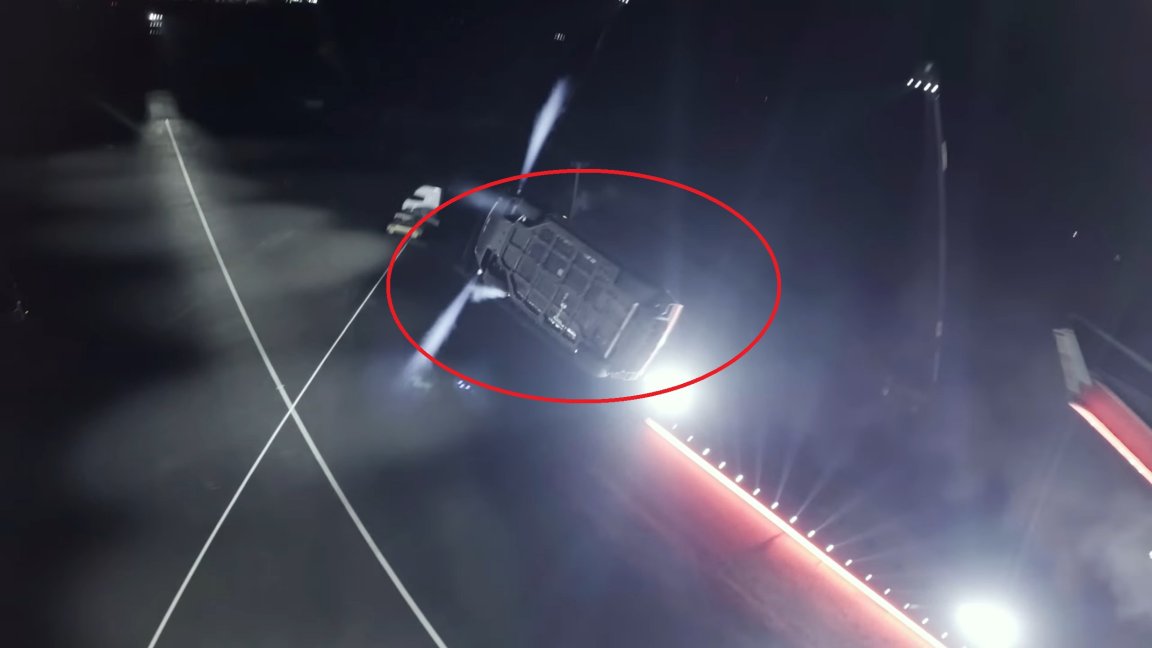
- Tesla
- Flying cars are right around the corner, if Tesla CEO Elon Musk is to be believed.
- Last week, he unveiled the automaker’s [long-awaited Roadster](https://futurism.com/advanced-transport/tesla-flying-roadster-cybertruck) by having it drive to the top of a ramp, flipping upside down in the process, then fling itself into the air before using its cold-fuel thrusters to gently land in style. Minutes later, another Roadster did its best Evel-Knievel-with-a-jetpack impression by blowing itself into the air and leaping over a row of six Tesla vehicles, including its Semi Truck cab.
- Sure, the Roadster can “fly.” There’s no denying that it was an impressive stunt. But huge questions remain, such as whether regulators will ever deem it road— let alone air — worthy. Another is if the cars used in the stunt will remotely resemble the actual product that’s sold to consumers, if such a thing does ever come to pass.
- Tesla says the “Rocket” version of its Roadster is loaded with 600 liters of compressed air, 10 directional cold-gas thruster nozzles, and a huge suction-fan system on the bottom. To make room for it all, Tesla says it removed the passenger seat.
- But some observers are wondering if the car is even more stripped down than that, perhaps even lacking a full-sized battery so the engineers could save room and cut down weight. Meanwhile, [screenshots](https://www.reddit.com/r/RealTesla/comments/1x8dny8/i_know_its_a_concept_carbut_am_i_wrong_that_this/) of the car’s sparse looking underside taken while it was midair seemed to show it lacking a suction fan, fueling further speculation that Tesla hasn’t figured out to fully combine its capabilities as they’re being presented. The car that stuck upside down to the top of the ramp and then cushioned its landing was, some skeptics allege, equipped with different hardware from the one that leaped into the air to leapfrog the other cars.
- Practical questions abound. Without a full-sized battery, the car obviously wouldn’t be able to drive around on roads even if it were allowed to.
- None other than computer scientist and “godfather” of AI Yann LeCun derided the Roadster’s aerial acrobatics display, calling it a “marketing stunt” and questioning its authenticity.
- “Even assuming that 50 percent of the mass of the car is the compressed air, that gives you less than 10s of useful thrust (with thrust-to-weight ratio larger than 1.0). Probably more like 5 seconds, actually,” he [wrote](https://x.com/ylecun/status/2111496760807895207) on X. “So the car must be an empty, lightweight shell containing big compressed air tanks. Cute demo, but totally impractical.”
- A little bit of misleading showmanship certainly isn’t below Musk. Tesla stunned the world in 2016 with a promotional video of its self-driving car puttering along public roads and dutifully stopping for red lights. Musk boasted that it was clear evidence that “Tesla drives itself.” But later, its engineers [admitted the whole thing was staged](https://www.reuters.com/technology/tesla-video-promoting-self-driving-was-staged-engineer-testifies-2023-01-17/).
- At its glitzy “We, Robot” event in 2024, Tesla tried to wow investors with its [Optimus humanoid robots](https://futurism.com/future-society/tesla-teleoperator-headset-optimus-fall) that poured drinks, danced on stage, and mingled with attendees while holding down a conversation. But it quickly became apparent that what Tesla had unleashed weren’t real-life C-3POs, because the seemingly autonomous robots were in reality [individually teleoperated](https://futurism.com/the-byte/tesla-robots-remotely-controlled-analyst).
- In any case, it’s impossible to verify what Musk’s showing off with the Roadster since Tesla isn’t allowing the public — journalists included — to take a peek under the hood.
- **More on Tesla:** [_Tesla Bros Using AI to Dream Up Improbable Scenarios Where the Flying Tesla Roadster Would Be Helpful_](https://futurism.com/advanced-transport/tesla-bros-ai-scenario-roadster)
All product names, logos and brands are property of their respective owners. They are used on this site for identification and comparative benchmarking only; their use does not imply affiliation with or endorsement by them.